

Remote staffing
Accounting Back Office Support Services
Outsourced bookkeeping operations: AP, AR, reconciliations and month-end prep run to a schedule so your accountant gets clean books, not a shoebox.
Bought under BPO Services From $350 per agent · live in 1 weeks

The bank balance looks healthy, but the ledger is two weeks behind. Supplier credits are still sitting in email, card transactions have no receipts, two customer payments remain unallocated and the accountant does not yet have the schedules needed for month end. The owner makes a cash decision from the bank screen because the books cannot answer in time.
That is the cost of late bookkeeping: the information arrives after the decision it should have supported. The work itself may be routine, but its value is time-bound. Accounting back office support buys a controlled calendar for capturing, matching, chasing, reconciling and preparing—not a loose block of hours used whenever the queue becomes uncomfortable.
OveliTHub supports transactional bookkeeping operations inside your approved systems. We do not provide tax advice, submit statutory filings, sign statutory accounts, perform an audit, give an audit opinion or issue a financial-statement opinion. Those judgments and regulated responsibilities remain with your qualified accountant, auditor, tax adviser and authorised company officers.
Late books create costs that are hard to see
A fortnight-old ledger can affect more than reporting. A supplier invoice may be entered twice because the first copy was not visible. A credit may go unused. A customer may receive a collection message after paying. A bank item may remain unidentified until nobody remembers it. A finance professional may spend paid advisory time reconstructing records that should have arrived clean.
Do not estimate the problem with an industry error percentage. Use the company’s own evidence for two representative months:
- days from transaction to complete, approved ledger entry;
- unreconciled bank and card items by age band;
- supplier invoices waiting for coding, match or approval;
- duplicate, corrected and reversed entries by cause;
- unallocated customer receipts and unapplied supplier credits;
- time the accountant spends cleaning inputs before review; and
- the working day on which the close-preparation pack is complete.
These measures establish whether support is making the books earlier and cleaner. They also separate backlog recovery from steady-state work—two different services with different capacity and pricing.
Control access before delegating work
Owners often ask, “Why would I give an outside team access to our money?” The starting answer is that a bookkeeper should not receive unrestricted authority merely because they need to process records. Access follows the task, and incompatible actions remain separated.
OveliTHub designs the proposed workflow around these controls:
- Separate preparation from approval. The person who captures and codes a supplier invoice does not become the sole person who approves and releases its payment.
- Use view, create, post and pay permissions deliberately. Grant only the actions required in the ledger, banking portal, receipt system and approval tool.
- Keep bank-account ownership with the client. Payment files or runs may be prepared within scope; authorised client signatories approve and release funds under the agreed bank controls.
- Require dual authorisation where risk and banking capability support it. Define thresholds, signatories, exceptions and what happens when an approver is absent.
- Use named accounts. Every person receives individual access with multi-factor authentication where supported; shared administrator credentials are excluded.
- Preserve source and audit trail. Attach or link invoices, receipts, approvals, coding rationale and correction history to the transaction where the system permits.
- Control master-data changes. New suppliers, bank-detail amendments, chart-of-account changes and opening balances follow separate verification and approval.
- Review exceptions. A forced match, unsupported journal, old unreconciled item or unusual payment is surfaced rather than hidden to make a dashboard appear complete.
- Revoke access the same day. A role change or departure triggers removal from the ledger, bank, document store, email groups and connected applications.
Segregation of duties is a control-design principle, not a guarantee against error or fraud. The 2025 U.S. GAO Green Book, written for federal internal controls, requires consideration of incompatible duties and alternative controls where separation is impractical. A private business should design controls for its own risks with its accountant, bank and advisers; a small team may use compensating review, alerts and independent bank reconciliation when full separation is not feasible.

To map these permissions before sharing credentials, book a free consultation. We will return a proposed responsibility and access matrix alongside the operating calendar.
The line between your accountant and the back office
| Back-office execution | Qualified accountant, adviser or authorised officer |
|---|---|
| Capture approved source documents and maintain records | Set accounting policies and materiality |
| Code within an approved chart and rule set | Judge unusual or complex accounting treatment |
| Match invoices to purchase and receipt evidence | Approve exceptions and contractual disputes |
| Prepare reconciliation and close schedules | Review, adjust and sign off the period |
| Prepare payment run for authorised approval | Authorise and release payment |
| Maintain requested audit-trail evidence | Provide assurance, tax advice or statutory filing |
Blurred ownership makes finance outsourcing unsafe and inefficient. A back-office team should not invent accounting policy; the accountant should not need to chase receipts or retype clean recurring entries. Establish a RACI—responsible, accountable, consulted and informed—for every material process, then give the reviewer a consistent handover pack.
Your accountant can work directly with the OveliTHub team through an agreed query and review channel. The client still owns the relationship, policy decisions and approval. If the accountant prefers a particular schedule or evidence format, we document it in the close checklist.
The work we take on, by ledger
Accounts payable
We can capture supplier invoices from approved sources, check required fields, identify duplicates, code against approved rules and route exceptions. Where the procurement process supports it, the team performs three-way matching between purchase order, receipt evidence and invoice. It prepares approval queues and payment runs without becoming the sole payment releaser.
Supplier statement reconciliation identifies invoices, credits, payments or balances present on one record but not the other. Exceptions are assigned an owner and age, not silently written off. Changes to supplier bank details use a verification path independent of the change request.
Accounts receivable
Within approved policy, the team can raise invoices from authorised source data, allocate receipts, maintain aged receivables, identify short or duplicate payments and run a documented reminder sequence. Disputes, credits, write-offs and collection escalation stay inside explicit monetary and policy limits.
This is trade receivables support, not medical revenue-cycle work. Insurance claim status, denial management and payer follow-up belong to AR follow-up support services or revenue cycle support services.
Bank and card reconciliation
We match bank, card, payment-processor and ledger records on the agreed daily or weekly cadence. Rules can handle recurring low-risk items, but unusual entries are documented for review. An unidentified amount remains in an exception queue with date, value, account, likely source and action—not forced against a convenient entry simply to clear the screen.
Reconciliation should account for timing differences, deposits in transit, fees, refunds, chargebacks and transfers. The approved accountant determines treatment where judgment is required. Old items receive an owner and escalation date.

Month-end close preparation
The team prepares the records and schedules the accountant needs: completed bank and card reconciliations, aged payable and receivable reviews, accrual and prepayment schedules from approved inputs, fixed-asset register upkeep, intercompany matching, suspense and exception lists, and supporting files for recurring journals. The qualified accountant reviews treatment, posts or approves judgmental entries and signs off the period.
The close pack names outstanding items, owner, value, reason, effect and expected resolution. “Complete” means the agreed evidence is available and the open exceptions are visible; it does not mean every unresolved item has been hidden.
Payroll processing remains outside this scope and belongs under payroll support services. The accounting back office can post authorised payroll summaries and reconcile related accounts if the accountant approves the mapping.
The finance calendar is the service
Hours are an input. The purchase is a reliable rhythm. A sample steady-state calendar might read:
| Cadence | Back-office output | Client/accountant dependency |
|---|---|---|
| Daily | New invoices and receipts captured; bank feeds triaged; urgent exceptions routed | Approvals and missing source documents by cutoff |
| Weekly | Payables run prepared; supplier statements sampled; aged receivables reviewed; bank/card exceptions reported | Payment approval, dispute decisions and collection exceptions |
| Working Day 1–2 | Cutoff checks, recurring records, remaining source capture and subledger review | Complete period inputs and cutoff instruction |
| Working Day 3 | Agreed bank, card and processor reconciliations prepared | Responses on unidentified material items |
| Working Day 4 | Aged-ledger, accrual, prepayment, asset and intercompany schedules prepared | Accounting judgments and approvals |
| Working Day 5 | Close-preparation pack delivered with exception register | Accountant review and period sign-off |
Working Day 5 is a proposed measurable target after steady state—not a universal promise. Final timing depends on volume, entities, currencies, integrations, source-document cutoffs, the starting backlog and reviewer availability. The service schedule states what counts as delivered, which client inputs are due and how a late dependency changes the date.
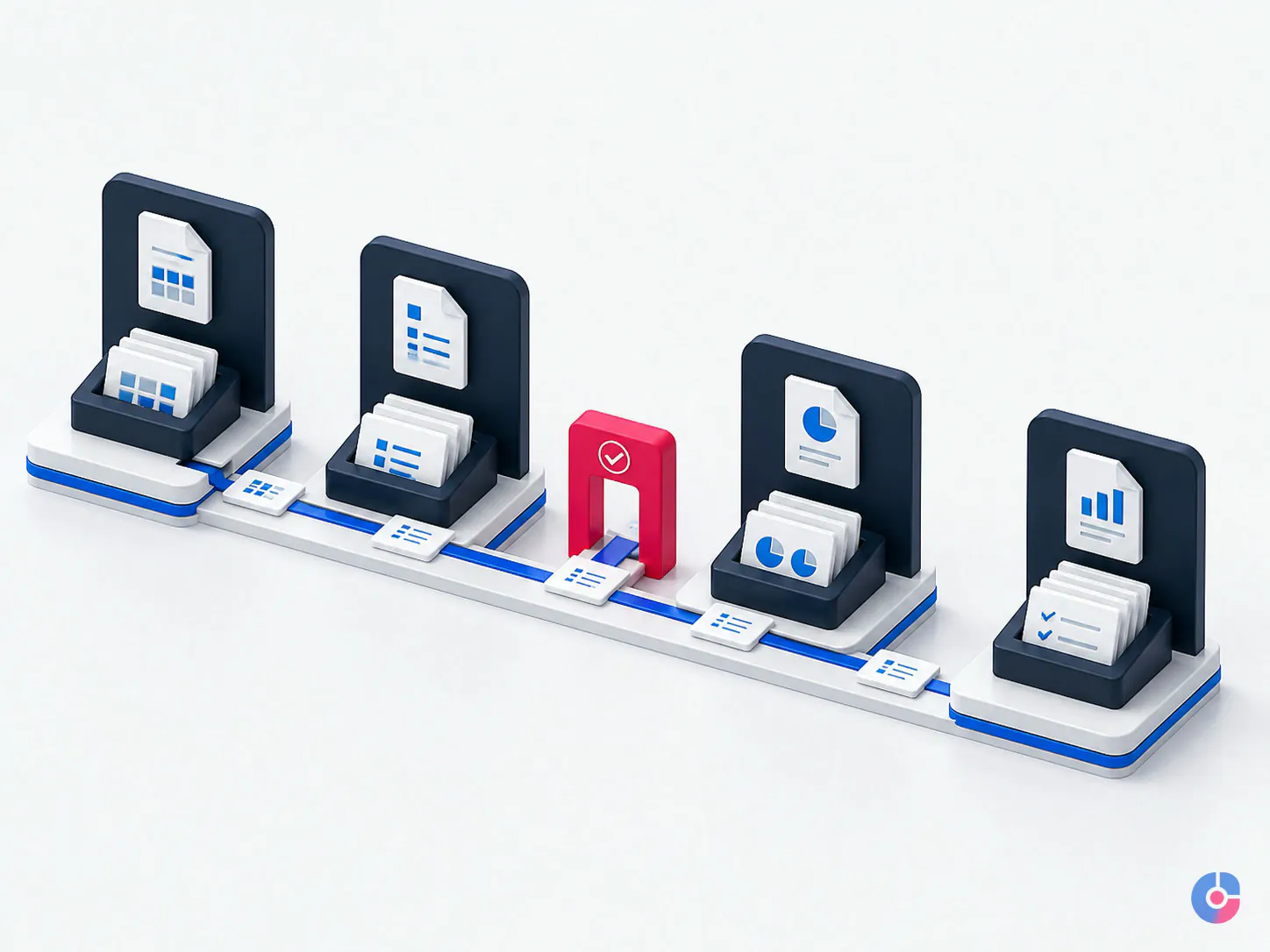
We work in the system you control
The team works through named accounts in the client’s approved ledger and document/approval stack rather than moving the books into an undisclosed OveliTHub system. Scope can include QuickBooks, Xero, Sage, Zoho Books and established NetSuite workflows where configuration, roles and accounting design are already owned by the client and qualified specialists.
Receipt capture, expense, payment approval, banking and document tools are mapped as part of the workflow. The exact available permissions depend on the client’s product, edition and configuration. For example, current QuickBooks Bill Pay role guidance distinguishes bill-approval and payment actions in eligible plans. We verify available roles in your environment rather than assuming a logo provides a control.
System ownership stays with the client. Administrator access, subscriptions, exports and recovery contacts must remain available if the service ends. Connected apps are inventoried, and data should move only through approved paths.
The first ninety days: cleanup, stabilisation, reliable close
Days 1–30: discover and clear the controlled backlog
We inventory accounts, entities, users, integrations, ledgers, bank/card feeds, open periods, aged items, existing SOPs and accountant requirements. A backlog register separates missing documents, unmatched records, duplicated entries, old balances, policy questions and access problems.
Month one can look messier than month zero because unresolved items become visible. That is useful if each exception has evidence, ownership and treatment from the accountant. We do not recode history or clear balances without authorisation. Backlog work is priced as a bounded cleanup project or separate capacity because it is not representative of the recurring monthly run.
Days 31–60: stabilise the recurring rhythm
Daily capture, weekly runs, aged reviews and reconciliation begin on the agreed cadence. Rules are tested against samples; approval and query turnaround is measured. We identify recurring causes such as late receipts, missing purchase orders or unclear coding instructions and assign process changes.
Days 61–90: prove the close date
The team runs the full working-day calendar, produces the standard pack and measures on-time inputs, reconciliations, exceptions, corrections and accountant review points. The target becomes credible only after it survives actual volume and reviewer feedback. Steady-state pricing is then based on recurring transaction bands, entities, accounts, workflows, service dates and exception rate.
For readers still deciding what belongs in scope, the paired guide covers which accounting tasks to outsource.
How quality is reviewed
Supervision combines preventive and detective controls:
- approved coding and matching rules with version owners;
- required source evidence and system validation;
- review of new suppliers, changed bank details and unusual journals;
- sample checks by transaction type and risk;
- reconciliations by a person independent of incompatible cash actions where practical;
- exception ageing and escalation;
- correction entries that preserve the audit trail instead of deleting evidence; and
- monthly root-cause review for recurring errors.
An error record states the source, affected transaction, detection, correction, approval and prevention change. Quality reporting includes volumes and sample results but never treats “zero visible exceptions” as success when items were forced or omitted.
Get a finance operating calendar for next month
Bring the monthly transaction volumes, entities, bank and card accounts, current working-day close, aged ledgers, software stack, approval path, backlog estimate and accountant’s handover requirements. We will propose the daily, weekly and month-end schedule, RACI, access matrix, exception controls and a separate plan for cleanup.
Set at the service, not here
The terms every BPO services engagement runs on
The price, the ownership and the renewal terms are the same whichever offering you buy, which is why they are published once rather than restated on every page.
- Starting price
- From $350 per agent per month, in US dollars. 4 hours a day, 5 days a week, one channel, documented SOPs and a monthly QA report. Live in 2 weeks
- Channels
- Email, live chat, phone, social inboxes, CRM and back-office systems
- Coverage
- Hours are stated per desk and written into the agreement, including which of your working days are covered from UTC+6
- Data protection
- UK GDPR Article 28 processor agreement, Standard Contractual Clauses and the UK IDTA where data leaves the UK or EEA
- Quality
- Monthly QA scoring against a rubric you approve, with the sampled tickets attached
- Tooling
- We work inside your helpdesk and your CRM. No forced migration to a platform we own
Bought together
Also in remote staffing
Market Research Assistant Services
Hire a market research assistant for competitor tracking, pricing sweeps and sourced briefing packs, so decisions rest on evidence you can check.
What it coversRemote Sales Support Team Services
Reps lose most of the week to admin, quotes and CRM updates. A remote sales support team runs the work behind the…
What it coversCalendar Management Services for Leaders
Calendar management with real booking rules, protected focus blocks and clean time zone handling. Get back the hours your diary quietly gives…
What it coversNext step
Tell us what you need from Accounting Back Office Support Services
Volume, hours and the systems it has to run in. The first reply carries a scope and a figure rather than a request for the basics.
- You send the brief A few lines is enough. No form fields you have to guess at.
- We reply in one business day With questions if we have them, and a range if we do not.
- You decide, not us No retainer to talk. If it is not our work, we say so.
Ask about Accounting Back Office Support Services
Priced per agent per month. The written procedure comes before the first agent is hired, so say what the work actually is.
We use what you send to answer you. We do not sell it, and we do not add you to a list.