

Custom Software
AI Business Automation Services
Automate documented business processes with AI plus human review. Cut manual handling time and keep an audit trail on every decision the system makes.
Bought under Custom Software Development From $550 · scoped per build

Three people receive the same supplier form. One copies the trading name, another uses the legal entity and a third leaves the field blank until finance replies. An automation is asked to “speed up onboarding,” so it encodes one version and sends the exceptions back as tickets. Within a month, the team is quietly correcting the system outside the workflow.
The failure began before the software. The business had not agreed what the process meant. Automation faithfully increased the speed and volume of that disagreement.
OveliTHub’s AI business automation services start with process readiness. We standardise the outcome, separate deterministic work from probabilistic work, establish a baseline, and only then build. Where the right answer is an integration or a rule—not a model—we say so. Where the process is not ready, documented human support is the responsible interim service.
Most failed automations were never only a technology problem
A convincing demonstration usually receives clean inputs and follows the expected path. Operations receives partial documents, changed templates, duplicate records, conflicting instructions, missing approvals and customers who describe the same issue five ways. The exception path is the product.
Common pre-technology failures include:
- no single owner can approve the definition of a correct output;
- staff follow several unwritten variants of the same task;
- input fields change without a schema owner or notice;
- the system of record is unclear;
- there is no safe state for low-confidence or incomplete work;
- nobody measured current volume, handling time, errors or exceptions; and
- the proposed automation depends on access the organisation should not grant.
A model cannot resolve those governance decisions. It can conceal them behind fluent output until an edge case exposes the gap. That produces a workflow nobody trusts and a team that maintains a manual shadow process indefinitely.
The four-question readiness test
1. Is the process written down?
“Someone knows how” does not qualify. A ready process has a trigger, required inputs, steps, accepted output, exception boundaries, accountable owner and evidence. The document need not be long; it must distinguish normal work from a decision.
If no: record representative walkthroughs, compare variants, agree the intended process and test an SOP manually. A business support assistant can operate and document the work while exceptions become visible.
2. Does one person own the outcome?
Automation needs an accountable business owner who can define correct, approve changes, fund review and stop the system. A committee may advise; one named role accepts the outcome and risk.
If no: create a RACI and resolve conflicting policy before building. The developer cannot become the default owner of a business decision merely because it is encoded.
3. Is the input stable enough to detect change?
Stable does not mean identical. It means expected formats, sources, languages, fields and variation are known, and the system can recognise when an upstream form, API, inbox or document has changed. Free text can be a valid input if its range is sampled and the uncertain cases have somewhere safe to go.
If no: standardise the capture, add validation, nominate a schema owner or limit the pilot to a stable subset. Do not make the model infer a changing contract that nobody monitors.
4. Can a wrong output be reversed?
Drafting a response for approval is reversible. Sending an unreviewed refund, deleting a record or making a consequential eligibility decision may not be. The safer pilot writes to a review queue or draft state before touching the system of record.
If no: add meaningful human approval, transaction limits, a rollback path and reconciliation—or keep the action manual. The greater the consequence and irreversibility, the stronger the case against autonomous execution.
Passing all four questions does not prove a positive return. It means the process is ready for a measured pilot. Baseline volume, current handling time, correction rate, delay, service level and cost before deciding whether to automate.
Book an Automation Readiness Review with two candidate processes. We will return a written pass, prepare or do-not-automate verdict for each, including the missing controls.
Where AI belongs, and where a rule is better
| Work pattern | Preferred mechanism | Reason |
|---|---|---|
| Exact routing from known fields | Rule or workflow engine | Predictable, testable and explainable |
| Calculations with defined formulae | Code, calculator or finance system | Produces reproducible numbers |
| Synchronising records between APIs | Integration with validation and retries | Maps known schemas and failure states |
| Scheduling from fixed constraints | Deterministic scheduler | Enforces explicit conditions |
| Classifying varied free text | Model plus threshold and review | Handles probabilistic language patterns |
| Extracting fields from varied documents | Document model plus schema checks and source evidence | Interprets layout and language variation |
| Drafting or summarising | Generative model with sources and approval | Produces a revisable first output |
| Answering from internal procedures | Retrieval plus cited source and fallback | Grounds the answer in approved material |
This should be a rule, not a model whenever the business can state the condition exactly. Do not ask a language model to calculate tax, decide whether an invoice total balances, copy a field available through an API or determine a due date from a fixed formula. Use deterministic software and let a model assist only with the unstructured part.
Generative output can still be confidently wrong. NIST’s 2024 Generative AI Profile uses the term confabulation for erroneous or false content presented confidently and treats it as a risk to manage. A polished sentence is therefore not validation.

Automations we build around controlled processes
Document and invoice processing
Incoming files are classified, required fields are extracted and values are checked against a defined schema. Deterministic controls verify formats, totals, duplicates, supplier or account references and required evidence. The workflow writes to a review queue or approved draft state before posting to finance or ERP systems.
Each extracted value can retain a link or location reference to the source where the tool supports it. Missing and low-confidence fields are never invented to complete a row. Reviewers see the original document, proposed value, failed checks and permitted actions.
Inbox and ticket triage
A model can classify free-text requests, detect language or intent, identify urgency signals and draft a first response from approved knowledge. Rules then route by channel, customer, severity and access boundary. During the pilot, a human approves outgoing messages; later autonomy is limited to validated low-risk cases if the evidence and policy justify it.
Routing quality is measured by reason and shift, not one overall accuracy number. A misrouted feature request and a missed safety or security report do not carry the same consequence.
Recurring reporting assembly
Rules and integrations retrieve defined figures from approved systems, validate dates and units, and assemble the recurring pack. A model may draft a narrative summary of visible changes, but it does not become the source of the numbers. The human owner reviews source completeness, reconciliations, definitions and commentary before release.
Dashboard strategy and analytical interpretation belong under data analytics services; this automation scope concerns repeatable assembly.
CRM and data hygiene
Automation can flag probable duplicates, standardise known formats and route incomplete records. A human approves uncertain merges and material enrichment. High-volume manual correction belongs under CRM data entry services until stable rules and examples justify automation.
Internal knowledge answering
A retrieval layer searches approved, versioned procedures and returns an answer with source links. If relevant authority is missing or conflicting, the assistant says so and routes the question. Permissions apply before retrieval, so a user cannot receive a source they were not authorised to open.
Retrieved documents and user text are treated as untrusted input, not as permission to change system rules or take an external action. Usage logs, feedback and unanswered questions identify missing knowledge and unsafe patterns.
Named failure modes and the control that catches each
| Failure | What it looks like | Control |
|---|---|---|
| Confabulated field | A missing invoice reference is filled with a plausible value | Required source evidence, schema validation and no-value fallback |
| Silent input drift | A changed form moves a field and extraction degrades | Schema/version checks, distribution alerts and fresh labelled samples |
| Hidden human exception | An experienced employee always checks a condition absent from the SOP | Shadow run, exception log and process-owner approval |
| Automation bias | Reviewers approve suggestions without checking evidence | Reviewer rubric, source visibility, override authority and audit samples |
| Duplicate or replayed action | A retry creates the same record or message twice | Idempotency, transaction keys, state checks and reconciliation |
| Unsupported external action | Free text causes an agent to call an unapproved tool | Tool allowlist, typed parameters, permission checks and approval gates |
| Vendor or model change | The same inputs produce materially different outputs | Version pinning where available, regression set, change review and rollback |
Human in the loop is an operating design
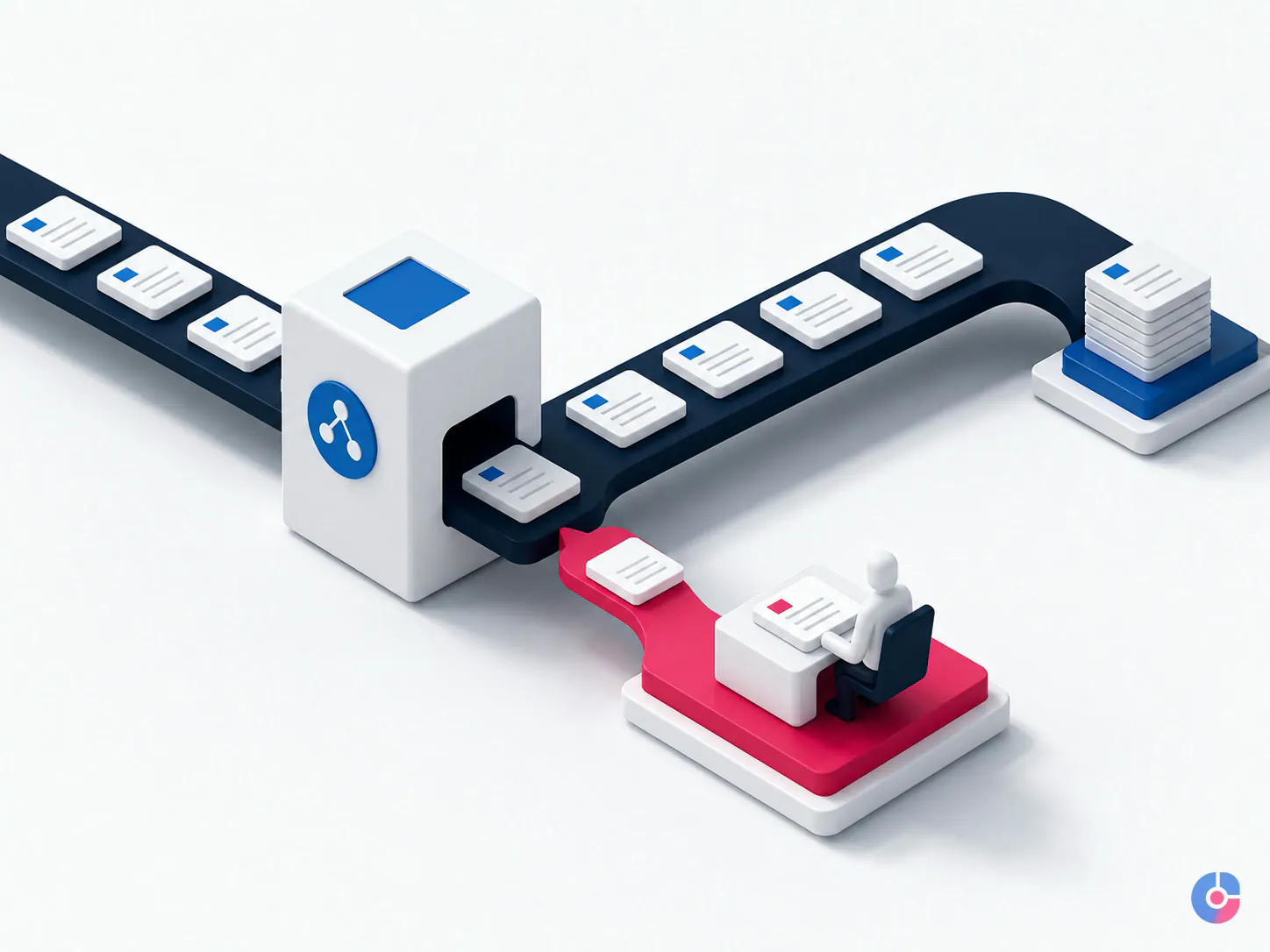
A “human-reviewed” label proves little. The reviewer needs the case, original evidence, proposed output, reason for routing, applicable rule, permitted actions and enough time to judge. They must be trained and authorised to reject the result.
We define:
- routing thresholds: derived from measured performance on representative labelled cases, not an arbitrary confidence number;
- mandatory review: categories that always require a person regardless of score;
- sampling: review of a changing portion of apparently high-confidence output to detect unseen error;
- escalation: who handles novel, sensitive, contradictory or high-consequence cases;
- override logs: original proposal, reviewer action, reason, model/rule version and final result; and
- fallback: manual or hybrid operation when thresholds, vendors or integrations fail.
ICO human-review guidance emphasises meaningful, documented review by people with appropriate knowledge, authority, independence and manageable workloads. It also recommends logging overrides and testing the review process. The guidance is currently under review following changes in UK law; confirm current requirements and obtain advice for the deployment.
For repetitive low-risk cases, review effort per 100 items should decline or stabilise at the designed rate as rules, sources and examples improve. Mandatory review for high-risk decisions may remain constant by policy. If ordinary exception and override load does not improve, the automation may have the wrong scope, unstable inputs, inadequate model, weak controls or no economic case. We pause expansion rather than using more human labour to preserve the appearance of automation.
What we monitor after go-live
An unmonitored automation is a production dependency with no accountable operator. The service report covers:
- input volume, throughput, queue age and failed transactions;
- exception and fallback rate by reason;
- measured quality against labelled samples and ground truth where available;
- human review, override and rework frequency;
- current handling time versus the pre-pilot baseline, using the same definition;
- estimated manual minutes avoided, reconciled against actual review and recovery effort;
- input-schema, source, model, prompt, rule and integration versions;
- drift or anomaly alerts and their disposition;
- incidents, unauthorised attempts and policy exceptions; and
- cost per completed accepted item, including model, infrastructure and review.
NIST’s voluntary AI RMF measurement playbook recommends comparing production behaviour with pre-deployment testing, monitoring for drift and anomalies, and assessing outputs against new ground truth as it becomes available. Our monitoring plan translates that risk logic into use-case-specific thresholds and owners; it is not a certification.

Governance, data and what we will not automate
Before any external model or platform receives data, the design records the fields, purpose, lawful basis where relevant, controller/processor roles, residency, transfer mechanism, retention, training-use settings, subprocessors, access, encryption, deletion and incident path. We minimise or pseudonymise inputs where practical and keep secrets outside prompts. The client approves vendors and data classes.
Logs record the workflow version, input identifier, validations, output, route, external actions and reviewer decision. They do not depend on storing a model’s hidden internal reasoning. Sensitive prompt and response content is retained only when justified and protected.
As an OveliTHub service policy, we will not fully automate:
- clinical diagnosis, treatment or safety decisions;
- legal advice, legal conclusions or final regulatory determinations;
- employment, credit, insurance, housing, education, disciplinary or eligibility decisions with legal or similarly significant effects on a person;
- unbounded payments, refunds, contract acceptance or irreversible deletion;
- identity, security or fraud actions without defined evidence, appeal and authorised oversight;
- communications presented as verified fact when the approved source is missing; or
- any action that bypasses a client’s required approval, segregation or professional sign-off.
A named human approver is necessary in many of these areas but may not be sufficient for legality, safety or fairness. The client must complete domain-specific legal, privacy, security and professional review. Where meaningful review cannot be designed, OveliTHub will not deploy the automation.
How an engagement runs
- Readiness and process capture. We assess two candidate processes, owners, SOPs, inputs, reversibility, data, risks and current evidence.
- Baseline and pilot decision. One bounded process receives a measurable quality, time, cost and service baseline plus pass/fail criteria.
- Architecture and controls. We choose rules, integrations, models and human steps; document permissions, vendors, thresholds, logs, fallback and refusal boundaries.
- Build and test. Representative normal, edge, adversarial and failure cases form a regression set. Reviewers train on the evidence and override path.
- Shadow run. Automation operates beside the current manual process without becoming the authoritative output. Differences reveal unwritten exceptions and unsafe assumptions.
- Controlled cutover. A limited volume enters production with mandatory review, reconciliation, a stop control and rollback.
- Supervision and expansion. We monitor quality, review load, drift, incidents and unit cost. More volume or autonomy is earned by evidence.
The shadow run is not optional for a material workflow. It is where the quiet human checks, malformed inputs and real queue behaviour surface without letting the new system create authoritative errors.
Book an automation readiness review
Bring two candidate processes, representative inputs and outputs, current steps, owners, exceptions, volume, handling time, systems, data classifications and consequence of error. OveliTHub will return a written verdict on readiness, the rule-versus-model boundary, missing controls and the smallest responsible pilot.
Set at the service, not here
The terms every custom software engagement runs on
The price, the ownership and the renewal terms are the same whichever offering you buy, which is why they are published once rather than restated on every page.
- Starting price
- From $550, in US dollars. Scoped per build after a written buy-versus-build split, so the figure you are quoted is for the part that genuinely has to be built.
- Typical stack
- Laravel or Node on the server, React or a server-rendered front end, PostgreSQL or MySQL
- Integrations
- REST and GraphQL APIs, webhooks, payment gateways, CRM and accounting systems, scheduled data syncs
- Delivery
- Fortnightly increments on a staging environment you can open at any time
- Testing
- Automated tests on the logic that would cost money to get wrong, plus a written manual pass before each release
- Documentation
- A written handover: architecture, environment variables, deployment, and how to run it locally
- What is transferred
- Source code, Git history, infrastructure accounts and any third-party keys, all in your name
- After launch
- A support window agreed in writing before the build starts, not offered afterwards
Bought together
Also in this service
Data Analytics Services for Business
Analytics services that define your metrics, fix your tracking and deliver a reporting rhythm your team acts on. Start with a measurement…
What it coversQA Testing Services for Web and Mobile
A broken checkout costs more than a testing budget. We run structured manual QA across browsers, devices and releases so defects surface…
What it coversDatabase Management Services
Managed database administration covering backups, tested restores, performance tuning, access control and migrations. Request a database health check.
What it coversNext step
Tell us what you need from AI Business Automation Services
Volume, hours and the systems it has to run in. The first reply carries a scope and a figure rather than a request for the basics.
- You send the brief A few lines is enough. No form fields you have to guess at.
- We reply in one business day With questions if we have them, and a range if we do not.
- You decide, not us No retainer to talk. If it is not our work, we say so.
Ask about AI Business Automation Services
The first thing we send back is a buy-versus-build split, so say what the process actually is rather than what you think the software should be.
We use what you send to answer you. We do not sell it, and we do not add you to a list.