

Back office and data
Data Verification Services
Verify contact, company and transactional records against authoritative sources, with a confidence flag and date on every check. Request a free sample.
Bought under BPO Services From $350 per agent · live in 1 weeks

The list imports without errors. Every email has an @ symbol, every postcode fits the field and every required column is populated. Then the campaign produces bounces, returned mail and replies saying the contact left months ago. A later compliance sample finds records whose source and last check nobody can explain.
The file was valid in format and unreliable in fact.
OveliTHub’s data verification services check values already present against approved evidence, record when each check was made and return four operational outcomes: confirmed, changed, unreachable and unverifiable. The objective is not a cosmetically cleaner file. It is a triaged dataset that tells the client which records can support the next campaign, migration, audit or operational decision.
Records do not merely contain errors; they become stale
A record can be entered correctly on Monday and become wrong later. A person changes employer or role. A company changes its trading name, group relationship or registered status. An office closes. A telephone number is reassigned. A domain expires. An address that remains historically true no longer describes the current destination.
Age alone does not determine truth. A decade-old incorporation date may remain accurate, while yesterday’s job title may already have changed. Verification frequency should therefore follow purpose, volatility and consequence rather than one universal refresh interval.
Validation and verification are also different. Validation tests a value against a rule: an email resembles the required syntax, a date is possible or a code appears in an allowed list. Verification asks whether the value represents the real current fact under the agreed purpose. alex@example-company.com can be perfectly formatted even if Alex left the organisation and the mailbox no longer exists.
We do not use an unsupported annual decay percentage. The buyer needs evidence about this file, these fields and this intended action. A representative sample exposes the current outcome mix without pretending every database ages at the same rate.

Use four outcomes, not a binary valid-or-invalid label
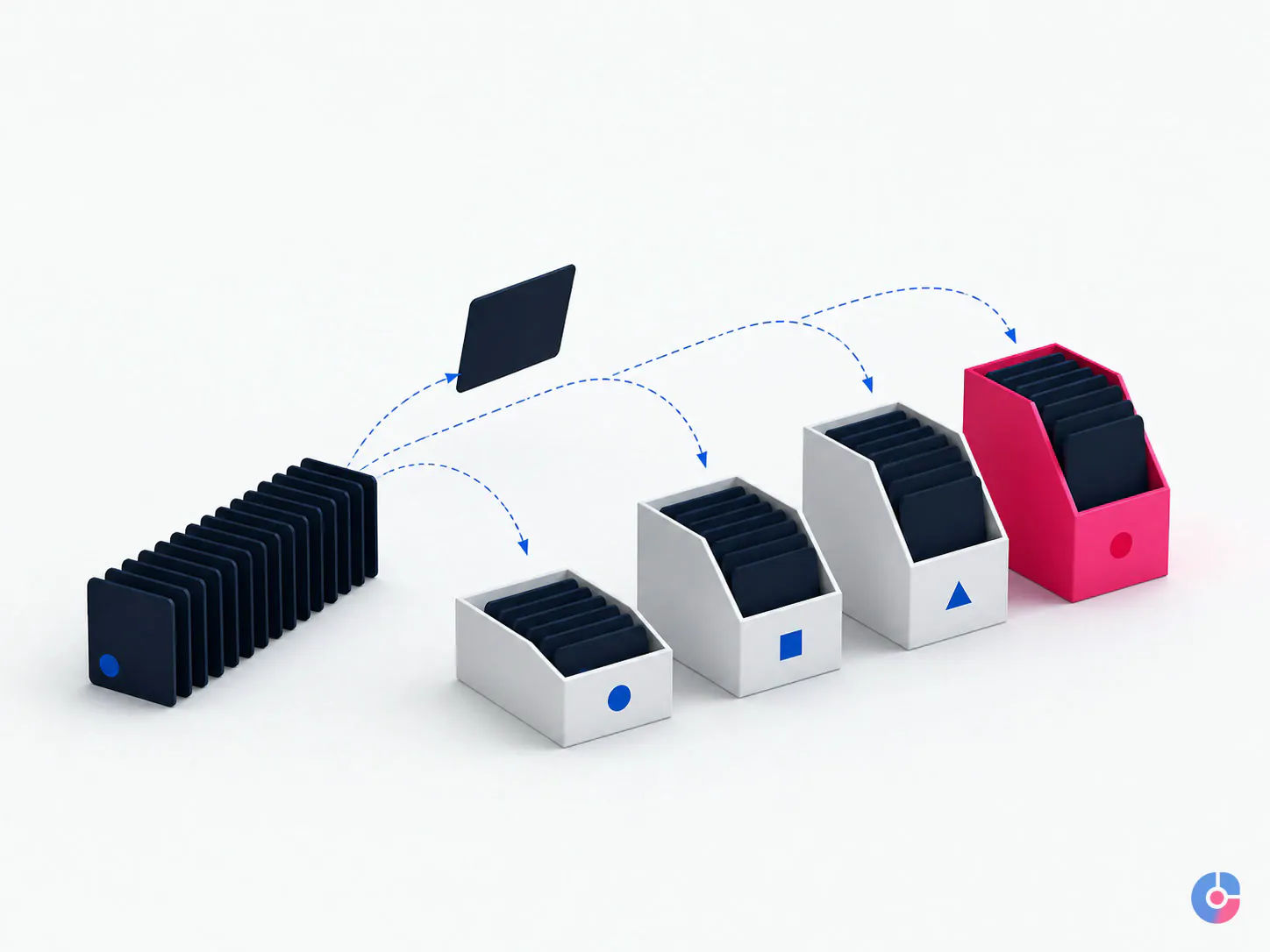
Binary output discards useful distinctions. A changed record may be recoverable, an unreachable record may still describe a real person or organisation, and an unverifiable record may simply lack sufficient permitted evidence. OveliTHub’s triage keeps these states separate:
| Outcome | Meaning | Recommended action |
|---|---|---|
| Confirmed | The existing value is supported by current, approved evidence and the entity match is unambiguous | Retain with verification date, source and next review rule appropriate to its use |
| Changed | The record matches the entity, but evidence supports a different current value | Preserve the original, append the proposed correction, review material changes and update through controlled import |
| Unreachable | The destination or channel cannot currently be reached under the agreed test, such as returned post or a definitive technical failure | Suppress that channel, investigate another approved channel if justified and retain only the evidence needed for the client’s purpose |
| Unverifiable | Available approved sources cannot confirm or refute the value, evidence conflicts or the entity cannot be matched safely | Quarantine, seek first-party confirmation or accept the documented uncertainty; never convert it into a guessed value |
A missing field is not automatically a verification outcome because there may be nothing to check. Adding an attribute that was never present belongs to data enrichment services. If a current field changes during verification, the corrected candidate is returned because the original claim has been tested; the project does not expand into discovering unrelated attributes.
What we verify
Contact records
Scope can cover name, current employer association, public professional role, business email signals, business telephone reachability and postal address. Each field has its own acceptable evidence and test. A company page may support a role; a current official directory may support an office number; an authoritative address reference may support a deliverable location. One source does not automatically verify every attribute on the row.
Email verification can combine syntax, domain and mail-exchange checks, an approved specialist tool, prior delivery response and manual employer evidence. A tool result is a signal, not a promise that a message will reach an inbox tomorrow. Catch-all domains, temporary server responses, filtering and mailbox policy can limit certainty. Nor does a technically reachable address prove consent, lawful basis or marketing permission.
Google’s current email sender guidelines, checked 2 September 2026, tell senders to monitor server responses, spam rate and domain reputation, and to reduce sending volume when messages start bouncing or being deferred. Verification is therefore one pre-send risk control; authentication, permission, content, unsubscribe handling, sending behaviour and monitoring remain part of campaign operations.
Company records
Depending on jurisdiction and purpose, checks can cover legal or trading name, registration identifier, operating status, registered address, official domain, group relationship, listed locations and industry classification. Registries and official filings carry more authority for legal facts than an unsourced directory, while the company’s current website may be more useful for its operating brand and locations. Conflicting dates or entities are reported rather than blended.
Group structures require care. A brand, branch, subsidiary and ultimate parent are not interchangeable, and an identical name can represent unrelated organisations in different countries. Stable identifiers, jurisdiction, domain, address and source context are used together to establish the match.
Transactional and internal records
A client-supplied reference set can be used to check whether identifiers, statuses, amounts, dates or category relationships agree across authorised systems. The rules define system of record, timing differences, tolerances, duplicates and exceptions. This is controlled cross-system verification, not outside-source fact discovery.
Creating records from documents belongs to data entry. Transforming and routing existing files at volume belongs to processing. Insurance eligibility or benefits checking for healthcare providers is a separate insurance verification support workflow with payer and patient-specific requirements.
Run the inexpensive automated layer before human research
Automation is appropriate for deterministic checks at scale: required format, domain existence, permitted code lists, checksum, exact identifier match, duplicate candidate generation, definitive system response and comparison with a clean client reference. It is fast, consistent and should handle work that does not require interpretation.
Human verification is justified when entity matching is ambiguous, two credible sources conflict, a company has restructured, a title needs context, a source is not machine-readable or a changed value requires evidential judgement. Researchers apply a documented source hierarchy and reason codes; they do not browse until they find a convenient answer.
A sensible sequence is:
- Profile without changing. Preserve the source and measure populated fields, formats, duplicates and stable identifiers.
- Apply deterministic checks. Run approved rules and tools, retaining raw result codes and timestamps.
- Remove settled records from manual work. Confirm or classify results that meet the agreed evidence rule.
- Route exceptions to researchers. Review ambiguous matches, changes and high-consequence fields with permitted sources.
- Escalate unresolved cases. Ask the client to decide conflicts, source restrictions or material corrections.
- Review a measured sample. Independently check outcomes against sources and status rules before release.
If a tool can answer the client’s question with acceptable evidence and auditability, we will recommend it. Manual hours should be reserved for records where judgement changes the business decision.
Every check carries a source, date and confidence
The output preserves the original value and can append verification status, proposed current value, source type, exact source reference, checked date, evidence date where available, method, confidence, limitation and action. If evidence applies only to one field, the provenance stays at field level rather than appearing to confirm the entire row.
Confidence definitions are agreed. A high-confidence company status might require an unambiguous match to a current official registry. A medium-confidence role might rely on consistent company-published and professional evidence that lacks a formal effective date. Unconfirmed or conflicting evidence becomes unverifiable, not a low-quality “confirmed” result.
Dates let the client set a field-specific re-verification rule. A frequently changing role can be reviewed before a major campaign, while a legal identifier may require review only on a relevant trigger. The project does not invent a universal shelf life.
Unverifiable records remain visible and controlled
Some people deliberately maintain little public information. Some private companies disclose minimal detail. A site may be unavailable, a registry may be delayed or two authorised systems may disagree. The correct result is a transparent exception with the attempted sources and limiting reason.
The client can place such records in a quarantine segment, suppress a specific channel, request first-party confirmation, send them to an authorised owner or retain them with a stated use limitation. Unreachable is channel-specific: an undeliverable postal address does not prove the company ceased trading. Unverifiable is evidence-specific: it does not prove the value false.
Suppression flags, objections, erasure instructions and legal holds are preserved through matching and import. Verification does not restore a do-not-contact record to campaign eligibility merely because the address is reachable.

Verify before an action makes stale records expensive
Before a CRM migration
A migration can turn old uncertainty into the new platform’s operating truth. Verification identifies current and questionable values before mapping, while stable IDs and original values preserve traceability. Deduplication, column standardisation and workbook repair remain a separate Excel data cleanup service; import execution and CRM field population can be scoped through CRM data entry services.
Before a campaign
Verify the fields used for audience selection, personalisation and delivery, carry suppression status and segment uncertain channels before sending. The purpose is not to claim guaranteed inbox placement. It is to avoid treating a format-valid list as current and to give campaign owners an evidence-based send, hold or review decision.
Before an audit or controlled review
An audit-oriented scope prioritises provenance, system-of-record agreement, evidence capture, status definitions, reviewer independence and change history. A correction must show the original value, supporting source, approval and time of change. Verification does not provide legal assurance or an audit opinion; it prepares an evidence trail for the authorised team.
Personal-data accuracy is more than a marketing preference
The ICO’s current guidance on the UK GDPR accuracy principle, checked 2 September 2026, says organisations should take reasonable steps to ensure personal data is not incorrect or misleading as a matter of fact, consider when it must be kept up to date, record its source and status, and correct or erase inaccurate data without delay where required. It also explains that the necessary steps depend on the data and the purpose for which it is used.
The ICO notes that this guidance is under review following the Data (Use and Access) Act. The client should obtain independent advice on the current law, lawful basis, transparency, rectification, erasure, retention, direct marketing, sector obligations and jurisdictions relevant to its use.
Verification instructions define how individual challenges, corrections and source conflicts are routed. A record of a past address can remain accurate if clearly identified as historical; changing it to a current address field without preserving meaning can make the database less accurate. Purpose and field definition govern the decision.
What you receive
The verification package normally contains:
- the untouched source file with stable record identifiers;
- a working output with confirmed, changed, unreachable or unverifiable status;
- the original and proposed corrected value where evidence supports change;
- field-level source reference, check date, method, confidence and limitation;
- channel-specific suppression or review recommendation where instructed;
- an exception log for ambiguous matches, conflicts and restricted checks;
- a summary by outcome and field rather than one opaque quality score;
- sample-review results with population, unit, method and findings; and
- an import-ready file or controlled write-back plan where separately approved.
The sample defines what counts as accepted before full production. We do not claim a universal verification accuracy rate or database size. Readers still comparing concepts can review data validation vs data verification before scoping a batch.
Request a verification sample on your data
Send a representative slice with stable IDs, the populated fields to check, intended use, acceptable sources, known suppressions and desired action for each outcome. OveliTHub will define the checks, provenance, confidence rules and review method before returning the four-way triage.
Request a free verification sample, email support@ovelit.com, or call +880 1707-510532. Browse all related digital services.
Set at the service, not here
The terms every BPO services engagement runs on
The price, the ownership and the renewal terms are the same whichever offering you buy, which is why they are published once rather than restated on every page.
- Starting price
- From $350 per agent per month, in US dollars. 4 hours a day, 5 days a week, one channel, documented SOPs and a monthly QA report. Live in 2 weeks
- Channels
- Email, live chat, phone, social inboxes, CRM and back-office systems
- Coverage
- Hours are stated per desk and written into the agreement, including which of your working days are covered from UTC+6
- Data protection
- UK GDPR Article 28 processor agreement, Standard Contractual Clauses and the UK IDTA where data leaves the UK or EEA
- Quality
- Monthly QA scoring against a rubric you approve, with the sampled tickets attached
- Tooling
- We work inside your helpdesk and your CRM. No forced migration to a platform we own
A tool does this for a fraction of the price. Why use researchers?
Use the tool for syntax, domain, format, exact match and other deterministic checks when its evidence meets your needs. Human review is for the exception set: ambiguous entities, role or corporate change, conflicting sources and high-consequence records. A blended pilot shows whether that layer adds enough value.
Our data is recent. Does it need verification?
Recency lowers some risks but does not prove current truth. A role, company status or channel can change soon after collection. Sample the fields that drive the intended action, then decide from the observed outcome mix and consequence.
Why not recollect every record?
First-party recollection can be the best route when permission, context or sensitive decisions require it. It may also lose contact with people who do not respond and repeat facts already supported by authoritative evidence. Verification triages which records can be retained, corrected or sent for recollection.
Can you guarantee an email will not bounce?
No. Technical and source checks describe evidence at a point in time; receiving systems and mailboxes can change or return temporary responses. The output records the method and date, while the sender continues to monitor responses and reputation.
Do you overwrite changed values?
Not during research. The original stays preserved, and the proposed value carries source, date, confidence and status. A separately approved import applies client rules, protects suppressions and records accepted and rejected changes.
How large is the free sample?
It is a small, bounded set agreed after reviewing fields, source access, sensitivity and complexity. It should represent ordinary and difficult records. Regulated, technically complex or high-risk checks may require paid discovery rather than a free production sample.
Bought together
Also in back office and data
Back Office Outsourcing Services
Outsource back office operations in the correct order, with SOPs written before handover. Lower operating cost without importing chaos into a new…
What it coversAdministrative Support Services for Business
Hand the scattered admin work to a trained remote team with documented SOPs. Return hours to your senior staff and stop tasks…
What it coversProperty Management Support Services
Maintenance chasing and tenant messages eat a manager's day. We run the coordination behind your doors so leases, repairs and owner reports…
What it coversNext step
Tell us what you need from Data Verification Services
Volume, hours and the systems it has to run in. The first reply carries a scope and a figure rather than a request for the basics.
- You send the brief A few lines is enough. No form fields you have to guess at.
- We reply in one business day With questions if we have them, and a range if we do not.
- You decide, not us No retainer to talk. If it is not our work, we say so.
Ask about Data Verification Services
Priced per agent per month. The written procedure comes before the first agent is hired, so say what the work actually is.
We use what you send to answer you. We do not sell it, and we do not add you to a list.