

Healthcare and regulated work
Home Healthcare Back Office Support
Referral response, caregiver scheduling, authorisation tracking and visit documentation support for home care agencies, staffed for the hours that break.
Bought under BPO Services From $350 per agent · live in 1 weeks

At 5:47 a.m., a caregiver reports that she cannot make a 7:00 visit. The scheduler must identify a qualified replacement, check geography and client preferences, offer the shift and record the response. Meanwhile, yesterday’s missed clock-out remains in the exception queue and an authorisation is approaching its unit limit.
That is the home care back office: small time windows, linked records and decisions with consequences for a person waiting at home. OveliTHub provides home healthcare back office support around the agency’s operating rules. The team can handle referral intake, schedule administration, authorisation registers, documentation follow-up, electronic visit verification exceptions, payroll inputs, billing preparation and caregiver-file coordination. Care delivery and agency authority remain with the agency.
The service is designed around three numbers the back office can directly influence: referral response time, caregiver fill rate and visits at risk of non-payment. It does not promise an industry benchmark. It establishes the agency’s own baseline, assigns each delay or exception, and staffs the hours in which the work actually arrives.
The referral you answered after the decision was made
A hospital discharge planner, case manager, payer coordinator or family may contact more than one provider. The agency cannot assume that receiving a fax, portal notification or voicemail means it has entered the conversation. Someone must acknowledge the referral, capture the information required for a capacity decision, identify missing documents and return a clear next step.
Speed matters, but this page does not claim that a referral is won or lost at a universal four-hour mark. Referral sources, service types, payer rules and local markets behave differently. OveliTHub measures the agency’s own record: received time, first qualified response, capacity decision, reason for delay, disposition and admission outcome. That evidence reveals where a faster process is commercially useful and where the constraint is clinical review, staffing, authorisation or incomplete information.
The three numbers a home care back office controls
Referral response time
Measure from the agreed receipt event to a qualified acknowledgement or next action—not an automated delivery receipt. Segment by source, service, day and hour so a weekend portal delay is not hidden inside a monthly average.
Caregiver fill rate
Define the denominator before reporting it: requested shifts, approved scheduled hours or another agreed population. Show filled on time, filled late, client-cancelled, caregiver-cancelled and unfilled separately. A headline percentage without these states can conceal disrupted care.
Visits at risk of non-payment
Count completed or scheduled visits with a known administrative risk: expired or exhausted authorisation, missing documentation, unresolved visit-verification exception, eligibility issue or incomplete billing input. Assign an owner and due date before the billing cut-off.
These are connected measures. A referral cannot move if capacity is unknown. A shift that appears filled can still produce an exception. A verified visit can still exceed approved units. The operating board therefore shows the referral, schedule, authorisation and visit states together, with the agency’s systems remaining the source of record.
Intake moves the referral to a real capacity decision
The intake procedure starts with the agency’s payer, service and jurisdiction requirements. Required fields can include referral source and contact, client identity and location, requested start, service and hours, payer, authorisation status, clinical documents, language or communication needs, household conditions relevant to staffing, preferred contact and consent status. Sensitive data is collected only through the approved channel and only when needed for the assigned work.
OveliTHub can monitor the agreed phone, secure fax, portal and inbox; time-stamp receipt; acknowledge the source; create or update the intake record; run an administrative completeness check; and chase named missing items. Capacity can be checked against the current schedule, eligible caregiver pool, service area and the agency’s matching rules. If a nurse or administrator must determine clinical suitability, the case moves with a complete review packet and a stated deadline.
The referral board uses explicit states: new, acknowledged, pending, capacity review, clinical review, accepted, declined and admitted. Each has an owner and next action.
Declines are coded. Capacity, geography, service mismatch, payer restriction and incomplete information point to different actions.
Caregiver scheduling is a controlled matching process
The schedule is not a game of putting any available name into an open block. Matching rules can include active status, role and permitted service, credential status, authorisation conditions, client preference, continuity, language, availability, geography, travel time, overtime rules, restrictions and the agency’s escalation policy. OveliTHub configures the operating checklist from those rules rather than inventing them.
The remote team can maintain recurring schedules, publish approved changes, identify conflicts, prepare open-shift lists, contact eligible caregivers through the agreed channel, record offers and responses, and update the standby list. Final assignment remains with the agency whenever policy, contract, licensure or management judgment requires it. Clinical skill assessment, suitability decisions and exceptions outside the matching rules are escalated.
An unfamiliar scheduler needs context and a recognised route. Transition begins with an agency announcement, recognised caller or sender identity, the existing scheduling system and approved scripts. Preferred names, contact windows and escalation paths stay in the shared record.
The call-out hour
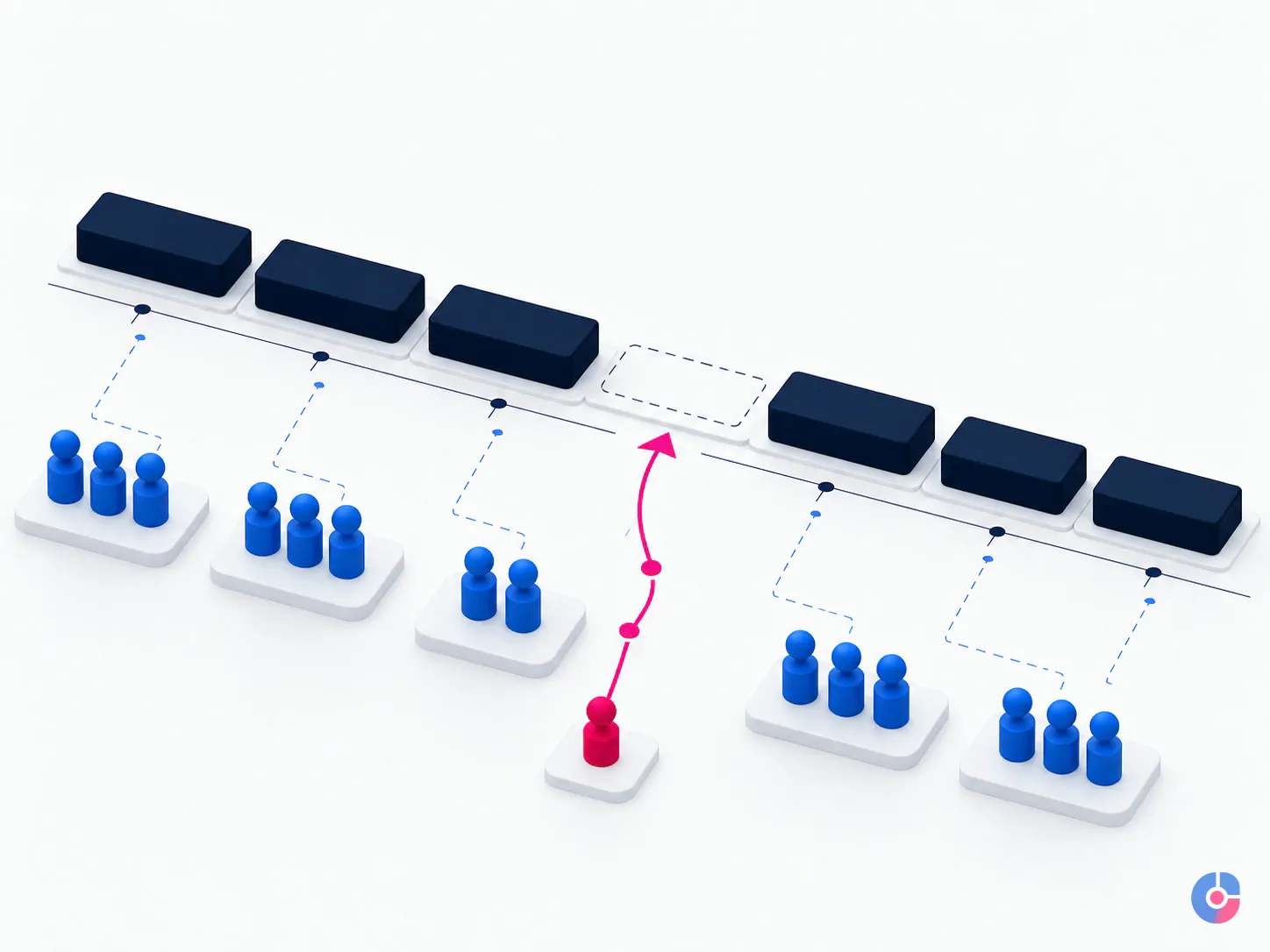
Early-morning call-outs compress the workflow. The operator confirms the absence through the approved route, checks whether the client or family must be notified, marks the shift at risk, searches the eligible pool, makes offers in the permitted order and escalates before the agency’s decision deadline. Every attempt and response is recorded in the scheduling platform.
A team working across time zones can make this period part of a normal staffed shift rather than an exhausted on-call task. That advantage is useful only if an agency decision-maker is reachable for exceptions and if the handover states what changed, what remains open and which clients need action. Offshore hours do not replace local authority.
Authorisation and eligibility need a live register
An authorisation letter sitting in a document folder does not protect the schedule. The operating register connects the client, payer or programme, authorised service, effective dates, approved units or hours, frequency constraints, identifier, source document, units scheduled, units verified or used, remaining balance, renewal requirement and responsible owner.
OveliTHub can enter authorised terms from the approved source, reconcile the schedule and completed-visit feed, and produce alerts at agency-defined time and unit thresholds. A fixed warning such as “30 days before expiry” may be appropriate for one programme and useless for another. Thresholds should reflect payer lead times, visit frequency and the agency’s renewal process.
The register does not interpret ambiguous coverage or approve care. A mismatch between the order, plan, schedule and authorisation is routed to the named clinical, payer or administrative owner. Renewal support can assemble the existing documents, identify missing items, prepare the submission packet and track follow-up. The agency or authorised professional reviews and submits it.

Daily visibility reduces preventable unpaid-work risk, but an administrative risk is not yet a denial or lost payment. This service prepares accurate inputs; claims, denials and receivables remain outside it.
Visit documentation and EVV exceptions are cleared daily
Electronic visit verification is not a universal rule for every home care visit or payer. Section 12006(a) of the 21st Century Cures Act requires states to implement EVV for Medicaid-funded personal care services and home health care services that require an in-home visit by a provider. Federal guidance identifies six verified data elements: service type, person receiving the service, person providing it, service date, service location, and start and end times. State implementation models and programme procedures vary. Agencies should follow the rules, systems and correction policies that apply to their state and service. Source: Medicaid.gov electronic visit verification guidance and CMS technical instructions for personal care and home health services, checked 2 September 2026.
The daily exception queue can include missed clock-in or clock-out, unmatched caregiver or client, location exception, overlapping visits, schedule variance, edited time, missing service code, absent visit note or a record rejected by an aggregator. OveliTHub can identify the exception, contact the authorised person using an approved script, collect the permitted evidence, attach it to the record and route corrections or attestations for approval.
The routine is deliberately daily:
- Import or review the prior service window. Confirm expected visits and the system’s exception statuses.
- Classify every exception. Separate technical, identity, time, location, schedule, documentation and authorisation issues.
- Prioritise by cut-off and consequence. Work visits nearing payroll, billing or payer deadlines first, while keeping older unresolved records visible.
- Collect permitted evidence. Use the agency’s correction process; do not invent time, location or service details.
- Route approval. The authorised agency role reviews manual edits, attestations and exceptions that require judgment.
- Validate the corrected state. Confirm acceptance in the applicable system and update the risk register.
- Report recurring causes. Identify device, training, scheduling, identity and workflow patterns that should be fixed upstream.

Daily follow-up reaches caregivers while the visit is recent and leaves time for agency review before cut-off. Recurring causes—training, device, connectivity, schedule data or integration—are then addressed upstream.
Payroll input and billing preparation share one reconciliation
The scheduled visit, verified visit, approved time, mileage or travel entry and authorised units should not live as unrelated truths. OveliTHub can reconcile the agreed fields, list variances and prepare the input package for the payroll provider and the billing package for the agency or its billing partner.
Typical controls include duplicate detection, unmatched worker or client, missing service code, schedule-to-actual variance, overtime flag, mileage support, authorisation balance, documentation completeness, manual-edit approval and cut-off status. The team does not decide whether a disputed shift should be paid, alter clinical documentation, approve payroll, submit a claim or post a payment. Those actions remain with the agency and its authorised partners.
Each delivery includes control totals, exceptions, decisions required, source date and version. This is reconciliation support, not a shadow payroll or billing system.
Recruitment and caregiver-file support protect usable capacity
OveliTHub can acknowledge applications, screen for stated administrative criteria, schedule interviews, issue reminders, chase references and approved documents, and keep the next step visible. Interviews, hiring, compensation and employment actions remain with the agency.
For active caregivers, the file register records required items, source, issue date, expiry date, verification status, restriction, owner and next action according to the agency’s policy. Alerts should be early enough for renewal, not merely announce that a document expired today. The scheduler receives the agency-approved availability status without being exposed to unnecessary file contents.
The team flags missing or expired items; the agency determines their scheduling or employment consequence. OveliTHub does not make disciplinary or credentialing decisions.
Coverage is designed for a home care week
A flat Monday-to-Friday office shift can miss the periods that create Monday’s backlog. The coverage study uses hourly arrivals for referrals, call-outs, schedule changes, documentation exceptions and caregiver questions. It maps early mornings, evenings, weekends, holidays, payer cut-offs and the agency’s own admission pattern.
| Operating window | Likely work | Required agency connection |
|---|---|---|
| Early morning | Absence intake, open-shift offers, first-visit risks and schedule handover | Named escalation owner for assignment and care-impact decisions |
| Business day | Admissions, authorisations, caregiver files, visit follow-up and partner coordination | Clinical, scheduling, HR and billing owners available by queue |
| Evening | Late referrals, next-day schedule checks, open shifts and documentation reminders | Defined response for urgent start-of-care or next-morning risk |
| Weekend | Call-outs, referral acknowledgement, active schedule changes and Monday preparation | On-call authority with an explicit escalation threshold |
The model may use staggered starts, extended hours, weekend rotations or another time zone. It specifies backup, handover, volume assumptions and surge response.
Book a free consultation to model coverage from the agency’s actual weekly arrivals. For the wider information-handling and healthcare governance model, review OveliTHub’s healthcare BPO services.
The team works in the agency’s systems and access boundary
OveliTHub uses the approved scheduling, applicant, document, EVV, communication and reporting systems where practical. A spreadsheet may be used as an authorised control register when the agency needs one, but it does not quietly replace the operational record. Integration begins with workflows and exports the agency already supports; custom development is scoped separately.
Access is role-based and limited by task. Intake, schedule update, document view, time correction, authorisation update, export, payroll approval and claim submission are distinct permissions. Named accounts, multi-factor authentication where supported, approved devices or environments, activity records, secure transfer and prompt offboarding are part of mobilisation.
Client and caregiver information is minimised in queues, reports and training. Staff do not copy sensitive data into personal messaging, private storage or unapproved AI tools. Retention, deletion, incidents and subcontractor access are established in the agreement.
What stays with the agency
The agency keeps clinical and statutory authority. OveliTHub does not conduct clinical assessments, determine eligibility for care, create or change a care plan, make clinical matching judgments, perform supervisory visits, direct treatment, make disciplinary or termination decisions, interpret ambiguous payer coverage, or act as the licensed professional or administrator of record.
The agency also retains final authority for admissions, assignments where required, manual time corrections, payroll, billing submission, credential exceptions, privacy decisions and incident response. The responsibility matrix names who prepares, checks, recommends, approves, submits and records each action. An outsourced coordinator does not inherit authority merely because the queue needs a quick answer.
This service focuses on caregiver shifts delivered in the home. It is not clinic appointment-booking support, medical billing or denial management. Buyers comparing adjacent services can browse the complete digital services catalogue or read the practical guide to home healthcare back office support services.
Mobilisation starts with one week of operating evidence
- Map the week. Use timestamped referrals, call-outs, open shifts, exceptions and cut-offs to locate the real workload.
- Define the states. Agree referral, shift, authorisation, visit and caregiver-file statuses, owners and aging rules.
- Set authority boundaries. Document decisions OveliTHub may execute, prepare or only escalate.
- Configure access and channels. Test named accounts, permissions, caller identity, secure communications and backup routes.
- Build the runbooks. Cover normal work, early-morning call-outs, missing documents, authorisation alerts, EVV exceptions and urgent escalation.
- Shadow and calibrate. Work a limited population under agency review and compare every update with the source record.
- Launch by queue. Transfer stable administrative categories, then expand only after accuracy, timeliness and escalation meet agreed acceptance rules.
OveliTHub brings healthcare-sector operating experience and the documented-process discipline developed across 130+ delivered projects. That portfolio is not presented as a claim of 130 home care agencies. This engagement establishes its own baseline, software procedures, state and payer rules, and acceptance evidence before the team operates independently.
The operating review connects speed with control
The daily board can show new and aging referrals; unfilled and at-risk shifts; call-outs awaiting a decision; authorisations approaching time or unit thresholds; prior-day visit exceptions; payroll or billing cut-offs; and caregiver files requiring action. The team begins with the records closest to a service, payroll, billing or compliance consequence.
The weekly review adds referral-response distribution, dispositions, fill, same-day replacements, authorisation exceptions, visits at risk of non-payment, EVV aging, manual corrections, payroll-file exceptions and recurring causes.
Metrics retain denominators, exclusions and source dates. Speed does not excuse empty acknowledgements, broken matching rules or edits without evidence. The purpose is a faster back office that preserves agency control.
Review your referral response time
Bring last month’s referral log, response timestamps, dispositions, unfilled shifts and current exception categories. OveliTHub will map the administrative delay, the hours it occurs and the first bounded queue suitable for transfer.
Review your referral response time, email support@ovelit.com, or call +880 1707-510532.
Set at the service, not here
The terms every BPO services engagement runs on
The price, the ownership and the renewal terms are the same whichever offering you buy, which is why they are published once rather than restated on every page.
- Starting price
- From $350 per agent per month, in US dollars. 4 hours a day, 5 days a week, one channel, documented SOPs and a monthly QA report. Live in 2 weeks
- Channels
- Email, live chat, phone, social inboxes, CRM and back-office systems
- Coverage
- Hours are stated per desk and written into the agreement, including which of your working days are covered from UTC+6
- Data protection
- UK GDPR Article 28 processor agreement, Standard Contractual Clauses and the UK IDTA where data leaves the UK or EEA
- Quality
- Monthly QA scoring against a rubric you approve, with the sampled tickets attached
- Tooling
- We work inside your helpdesk and your CRM. No forced migration to a platform we own
Can OveliTHub assign caregivers to clients?
The team can apply documented eligibility and matching rules, identify candidates, offer open shifts and prepare an assignment. Final approval stays with the agency wherever its policy, contract, licensure or judgment requires it. Clinical suitability decisions always escalate.
Will caregivers accept messages from a remote scheduler?
Adoption is managed deliberately: the agency announces the team, uses recognised contact details, preserves established channels and gives staff accurate schedule context. Complex, sensitive or disciplinary conversations return to the agency.
Does EVV apply to every home care visit?
No. The federal requirement concerns specified Medicaid-funded personal care and home health services requiring an in-home provider visit. State programmes implement their own models and procedures, and other payers may have separate requirements. The agency defines which visits enter its EVV workflow.
Can the team correct missed clock-ins?
It can investigate the exception, collect permitted evidence and prepare the correction. Manual edits, attestations and approvals follow the agency’s state-, payer- and system-specific procedure and remain with an authorised role where required.
Do you replace our scheduling software?
No. OveliTHub normally works inside the agency’s approved platform and supported integrations. The mobilisation phase tests access, field definitions, queues, exports and version control before live work moves.
Where does billing support stop?
The team reconciles schedule, verification, authorisation and approved documentation fields, then prepares a controlled billing input package. The agency or its authorised billing partner reviews and submits claims, manages denials and posts payment.
Bought together
Also in healthcare and regulated work
Revenue Cycle Support Services (RCM)
Offshore RCM support across eligibility, charge entry, claim follow-up and denials, with weekly AR reporting. Request a revenue cycle review.
What it coversPrior Authorization Support Services
Prior authorization delays cancel appointments and stall revenue. We submit, track and appeal auth requests so your clinical schedule stays full.
What it coversAR Follow Up Support Services for Practices
Trained AR specialists working aged claims by bucket and denial reason. Reduce days in AR and recover revenue that is quietly sitting…
What it coversNext step
Tell us what you need from Home Healthcare Back Office Support
Volume, hours and the systems it has to run in. The first reply carries a scope and a figure rather than a request for the basics.
- You send the brief A few lines is enough. No form fields you have to guess at.
- We reply in one business day With questions if we have them, and a range if we do not.
- You decide, not us No retainer to talk. If it is not our work, we say so.
Ask about Home Healthcare Back Office Support
Priced per agent per month. The written procedure comes before the first agent is hired, so say what the work actually is.
We use what you send to answer you. We do not sell it, and we do not add you to a list.