

Digital Marketing
Web Scraping & Data Extraction Services
Managed web scraping with schema design, validation and scheduled refreshes, delivered as clean data to your systems. Request a feasibility review.
Bought under Digital Marketing From $300/mo · ad spend excluded

A scraper that works once is a demonstration. A dependable data service must still produce current, interpretable records when a source changes, an item disappears or one field quietly switches format. OveliTHub’s web scraping services combine schema design, managed collection, validation, change detection and accountable delivery.
We assess whether collection is technically, contractually and ethically defensible before building. Public visibility is not the same as permission for every reuse. An official API or licensed dataset may be the better route. When extraction is appropriate, the client owns the collected deliverables and documented schema under the agreement, with source rights and third-party restrictions still respected.
The problem is never getting the data once
A selector finds a price in week one. In week six, the source redesigns its product card. The job still runs, but the price field becomes empty or captures a promotional label. A dashboard refreshes successfully and decision-makers see stale or malformed numbers with no warning.
That failure begins outside extraction. Nobody defined what a valid record was, how freshness would be measured or who should be alerted. A managed feed needs a contract for the data: source, fields, definitions, expected behaviour, cadence, acceptance checks and response when confidence falls.
We treat source change as normal operating risk. Monitoring compares structure and output patterns, failed runs are quarantined and repairs are tested against representative cases before backfill. The product is not a clever parser; it is evidence that downstream users can judge.

Define the schema before writing a single selector
The first deliverable describes each field: name, business meaning, data type, permitted values, units, currency, time zone, null behaviour, source evidence and transformation. It also identifies the key that connects the record to the client’s warehouse, catalogue, CRM or research model.
Names alone are insufficient. “Price” may mean list price, current price, unit price, member price or a range. A date may describe publication, observation or effective period. The schema resolves those differences before thousands of ambiguous cells arrive.
Identifier strategy is equally important. Source IDs are preferred where stable and permitted. Otherwise a documented composite or client crosswalk may be required. Fuzzy matching is labelled with confidence and review, not presented as a deterministic key.
Sample records expose edge cases: variants, pagination, missing values, multiple currencies, duplicated listings and temporary unavailability. The client signs off definitions and a representative extraction before production scheduling.
What we build and run
- Source assessment: examine access, structure, terms, data sensitivity, rate behaviour, alternative channels and representative edge cases.
- Extraction pipeline: collect only approved fields with traceable source and observation time.
- Schedule: set refresh frequency from business need, source tolerance and change rate rather than maximum possible requests.
- Validation: apply schema, range, presence, variance, duplicate and relationship rules before release.
- Normalisation: standardise agreed types, units, categories and identifiers while preserving raw evidence where required.
- Change detection: observe structural and output shifts, classify severity and alert the named owner.
- Delivery: load accepted records to the approved destination with run metadata, rejects and status.
- Maintenance: investigate failures, adjust controlled logic, retest and backfill within the service boundary.
Existing records that need append or improvement belong with data enrichment services. Complex cleaning and transformation after collection may use data processing services. Interpretation and decision reporting belong with data analytics services.
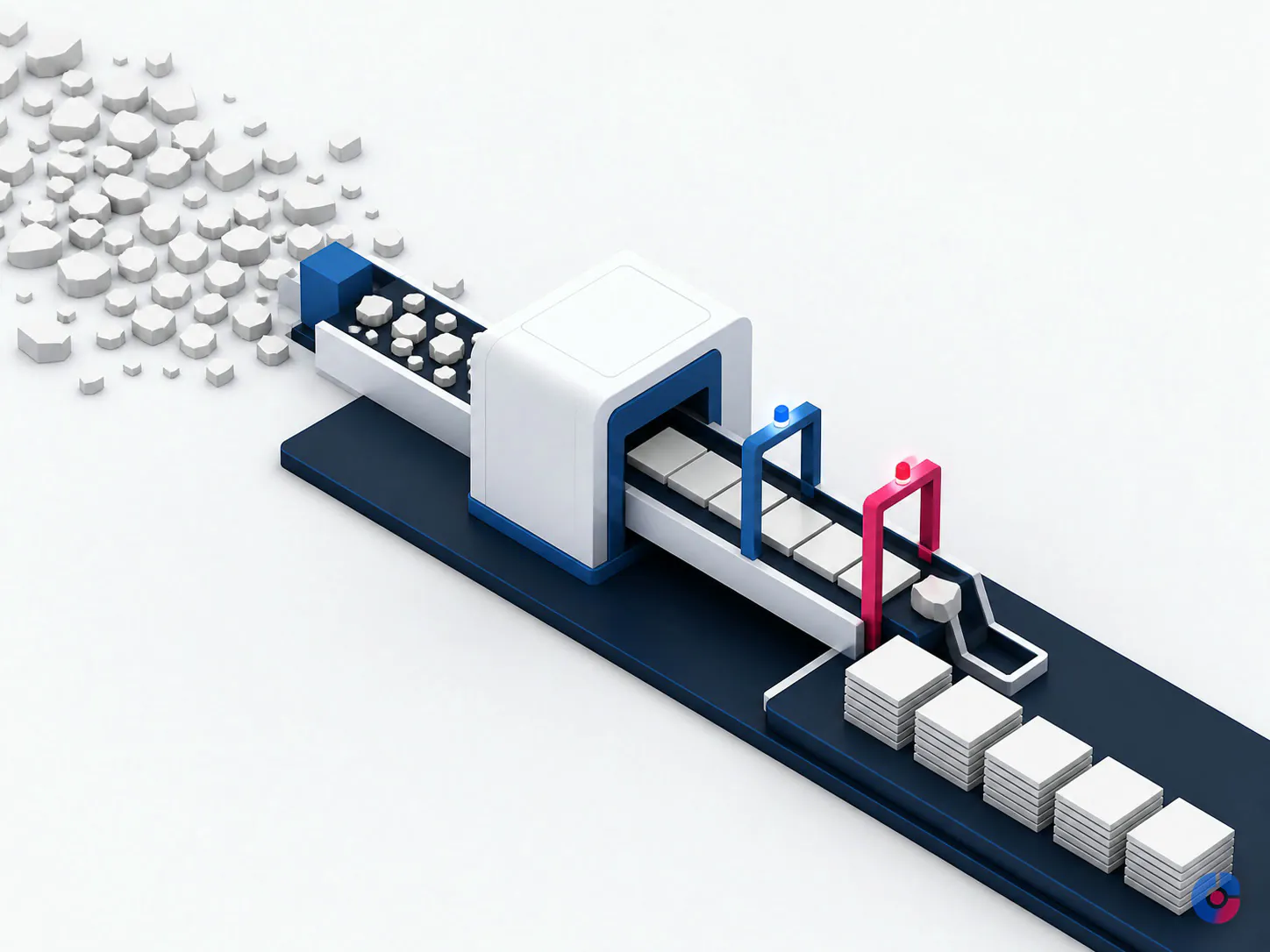
Validation is the difference between data and noise
Each run checks required-field presence, type, permitted range, unit, referential integrity, duplicates and freshness. Row count and null rate are compared with previous accepted runs and expected seasonal behaviour. Source coverage is checked so a successful first page does not conceal failed pagination.
A failed rule does not automatically delete or publish data. Records enter quarantine with reason, observed source and run identifier. Severity determines whether delivery pauses, unaffected records continue or the whole snapshot is withheld. Alerts describe impact and next action instead of reporting only a technical exception.
Quality summaries show accepted, rejected, changed and missing records. If a repair modifies historical interpretation, the change log and any backfill are visible to the client.

Common use cases we support
- Price and availability monitoring: observe public offers using explicit product matching, currency and availability definitions.
- Product catalogues: collect permitted specifications, categories and variant structure for comparison, migration or research.
- Marketplace tracking: monitor listing status and approved public attributes across a defined seller or product set.
- Property or job aggregation: create current snapshots with deduplication, location rules and expiry handling.
- Directories and companies: collect approved organisational facts with provenance and limits on personal information.
- Reviews and ratings: observe public aggregate or content fields where terms, rights and intended use permit, preserving observation dates.
We do not name target sites casually or imply permission through past technical access. Ecommerce and real estate experience helps identify catalogue, listing and identifier problems, but every source receives its own review.
Manual, judgement-led discovery is different from automated web collection. For research-led lead development, see online research services for lead generation. For catalogue entry after collection, consider product data entry services.
Handling change, blocking and rate limits responsibly
Source owners redesign markup, introduce consent flows, change pagination, throttle traffic and protect capacity. The pipeline identifies itself where appropriate, follows approved access conditions, requests only what is required and uses caching so unchanged resources are not fetched repeatedly.
Rate and concurrency are conservative and source-specific. Retries use limits and backoff instead of turning a temporary failure into aggressive traffic. A circuit breaker pauses collection when error or block patterns cross the agreed threshold. We do not rotate identities to defeat a clear access restriction.
The Robots Exclusion Protocol allows service owners to communicate crawler access rules. RFC 9309 also makes clear that robots.txt is not access authorisation or a substitute for security. We respect applicable directives as one input to the review; permission, terms, law and purpose still require separate consideration. Read RFC 9309.
When a source blocks the service, we stop, diagnose and inform the client. Options may include reducing cadence, using an official channel, securing permission, adjusting the scope or ending that source. Continuity is never promised through circumvention.
Legality, terms and what we will not scrape
Automated access can engage contract, database, copyright, privacy, computer misuse, competition and sector rules. The position differs by jurisdiction, facts, source and reuse. This page is operational information, not legal advice; the client remains responsible for a lawful purpose and should obtain qualified advice where risk exists.
Publicly accessible does not mean freely reusable. A page may display protected expression, licensed images or personal information. EU GDPR explicitly covers automated processing of personal data, including information obtained from publicly accessible sources. UK privacy regulators have likewise warned that public availability does not remove data-protection responsibility. See the official GDPR text and the ICO-hosted joint statement on data scraping and privacy.
The review documents source terms, access method, field sensitivity, intended use, retention, recipients and client legal position. Data minimisation removes fields without an approved need. Personal data receives purpose, notice, rights, security and retention consideration appropriate to the client’s jurisdiction and role.
We decline requests to bypass authentication or effective access controls, evade a clear block, collect credentials or payment data, assemble sensitive personal profiles without a defensible basis, copy protected content as a substitute for licensing, target vulnerable people, facilitate harassment or deception, or misrepresent collection as authorised.
A decline is part of responsible delivery. Technical possibility does not create a business case or permission.
Delivery formats and integration
Accepted data can be delivered as CSV or Excel, JSON, a cloud-storage drop, scheduled email, direct database load, API endpoint or controlled push into a CRM or BI system. The choice depends on volume, update behaviour, security, retry needs and the receiving team’s capability.
Each delivery includes observation time, run identifier, schema version and status. Incremental feeds identify insert, update and removal semantics. Full snapshots make state straightforward but may be inefficient. Database work, retention and access can be coordinated with database management services.
Historical snapshots have an agreed retention period, granularity and storage owner. Raw evidence, transformed output and rejected records may require different periods. Deletion, export and restoration are tested where business continuity depends on them.
When an API or licensed dataset is the better answer
An official API often provides stable identifiers, documented fields, predictable limits and a recognised commercial relationship. A licensed dataset may already solve entity resolution, update and rights issues at lower total cost. Scraping should not be selected because its initial prototype appears cheaper.
We compare coverage, licence, allowed uses, history, latency, data quality, integration, outage responsibility and exit. An API can still change or omit fields; scraping can sometimes access important public context no feed offers. The feasibility review makes that trade-off explicit.
If the client already owns suitable data and only needs it cleaned, joined or enriched, building a crawler adds risk without value. We redirect the work to the appropriate data service.
Feasibility review before any commitment
The review returns assessed sources, representative access observations, achievable and uncertain fields, expected record volume range, proposed refresh cadence, identifier approach, validation plan, delivery options and risk register. It also states what should not or cannot be collected reliably.
A small pilot tests the highest-risk fields and edge cases. It is not presented as production merely because rows appeared. The client approves the schema and acceptance criteria, then receives a production proposal covering monitoring, maintenance, response, storage and change.
How an engagement starts
- complete the feasibility review and identify legal or source-owner decisions;
- sign off the target schema, identifiers, validation and output destination;
- run a bounded pilot against representative source states;
- tune rules and approve a sample plus failure behaviour;
- schedule production collection with monitoring, alerts and named support.
For background on downstream operations, read how data processing services work. No collected volume or accuracy is promised before source evidence and a pilot support it.
Commission a data feed you can inspect
Bring the sources, exact fields, intended use, update decision and receiving system. We will establish feasibility and refuse assumptions the evidence cannot support.
Request a scraping feasibility review or explore all digital services.
Set at the service, not here
The terms every digital marketing engagement runs on
The price, the ownership and the renewal terms are the same whichever offering you buy, which is why they are published once rather than restated on every page.
- Starting price
- From $300 per month, in US dollars, on a 3-month minimum. One channel, run properly: Meta advertising from $300, TikTok advertising from $300, Google advertising from $350 and Local SEO from $550, each per month. Advertising spend is excluded
- Excluded from the fee
- Advertising spend. It is paid by you, directly to Google and Meta, from your own accounts
- Measurement
- GA4, Google Search Console and platform conversion tracking, configured and verified before the first campaign runs
- Account ownership
- Google Ads, Meta Business, GA4 and Search Console are yours. We are granted access; we do not hold the accounts
- Reporting
- Monthly, with plain-language commentary. Impressions go in the appendix
- Renewal
- Nothing renews automatically. The minimum term exists because search and paid channels need time to produce data worth reading
How much data can you collect?
Volume depends on permitted access, source structure, change rate, validation and delivery capacity. The feasibility review estimates a responsible range; maximum request speed is not treated as the target.
How often can the data refresh?
Cadence follows the business decision, source tolerance and terms. Near-real-time collection is not appropriate when daily or weekly observation provides the same value at lower risk.
What happens if a source blocks collection?
We pause affected work, preserve the last accepted data, diagnose and report options. We do not promise evasion. A licensed source, API, reduced cadence, permission or removal may be required.
How long is data retained?
The agreement defines retention for raw evidence, accepted snapshots, rejects, logs and backups. The client can select a policy consistent with purpose, licences and legal advice.
Who owns the pipeline and data?
The client owns collected deliverables and the documented schema under the contract. Bespoke pipeline ownership or licence, deployment artefacts and handoff are stated separately; source and third-party rights remain unaffected.
Bought together
Also in this service
Digital Marketing Support Team
Add trained marketing execution capacity behind your in-house lead, covering production, trafficking, reporting and QA. Book a capacity review.
What it coversB2B Lead Generation Services
B2B lead generation built on a tight ICP and researched lists. Fill your pipeline with conversations your sales team will actually want…
What it coversContent Localization Services for Markets
Localize content for real markets, not just languages. Adapted offers, local proof and correct hreflang so the right page ranks for the…
What it coversNext step
Tell us what you need from Web Scraping & Data Extraction Services
Volume, hours and the systems it has to run in. The first reply carries a scope and a figure rather than a request for the basics.
- You send the brief A few lines is enough. No form fields you have to guess at.
- We reply in one business day With questions if we have them, and a range if we do not.
- You decide, not us No retainer to talk. If it is not our work, we say so.
Ask about Web Scraping & Data Extraction Services
Advertising spend is paid by you, straight to the platforms. The retainer is the fee, and it is quoted against what an enquiry currently costs you.
We use what you send to answer you. We do not sell it, and we do not add you to a list.