

Healthcare & specialist
Medical Records Management Support
Records support that indexes charts, prepares them for clinic and releases them inside the legal window, with an audit trail on every access.

The referral letter arrived yesterday. A staff member can see it in the fax platform, but the clinician cannot find it in the chart. Someone calls the referring office during clinic, another copy arrives, and the schedule slips while the record now contains two versions of the same document.
The document was not missing. It was functionally lost between intake and the correct patient, encounter and document type.
OVELITHUB provides medical records management support for that controlled lifecycle: intake, classification, indexing, chart preparation, request logging, release-of-information administration, backfile coordination and retention-schedule maintenance. The team handles records and custody evidence. It does not interpret clinical content, make care decisions or change a clinician’s documentation.
A document that exists but cannot be found is an indexing failure
Scanning or uploading creates a file. Records management makes that file retrievable, attributable and governed. A useful indexed item connects the correct patient, encounter or episode, document type, service or document date, source, status and any routing requirement according to the client’s EHR design.
The operational cost of poor indexing appears everywhere: clinicians open incomplete pre-visit charts; staff search a fax archive; records teams miss an item in a response set; quality staff cannot locate supporting material; and duplicate requests create duplicate files. The remedy is not faster free-text naming. It is a controlled document dictionary, defined matching evidence and an exception queue.
OVELITHUB works from the client’s naming, patient-matching, document-correction and duplicate-handling policies. Where those rules are incomplete, the team maps the ambiguity and asks the health information or compliance owner to decide. An administrator does not infer that two patients are the same because their names look similar.
High-volume field entry into health forms or administrative records is a different workload, covered by healthcare data entry services. This page is about custody and lifecycle of clinical-record documents.
Two clocks govern the records queue
The release-of-information clock begins according to the governing rule and the client’s request procedure. It may attach a legal outer limit, state requirement, contractual duty or authorised extension process. Staff must know the receipt timestamp, applicable rule, request status and escalation date.
The chart-readiness clock is operational. A clinic may require outside records, referrals, results and other supplied documents to be indexed and routed before the appointment or a defined review point. Its deadline derives from the clinic schedule and workflow, not automatically from a patient-access law.
Mixing both in one oldest-first queue makes the priorities opaque. A request with a longer legal outer limit can still require immediate identity or scope clarification. A referral for tomorrow’s clinic may need rapid indexing without becoming a release-of-information request. OVELITHUB separates the queues while reporting shared capacity constraints.
| Queue | Primary clock | Completion evidence |
|---|---|---|
| Incoming document indexing | Receipt to indexed, routed or exception status | EHR document ID, patient and encounter match, type, timestamp and route |
| Pre-clinic preparation | Appointment or review cutoff | Checklist complete or named missing-item escalation |
| Individual access request | Receipt under applicable law and client policy | Request log, verified scope, action and delivery or written exception evidence |
| External records request | Approved service target and any governing requirement | Authorisation decision, fulfilled set, dispatch confirmation or documented hold |
| Backfile | Project burn-down schedule | Indexed and quality-checked batch with reconciliation |
What the records support team handles
- Document intake: monitor approved fax, portal, mail-scanning and secure-email routes; timestamp receipt; detect unreadable, incomplete or duplicate material.
- Classification and indexing: match authorised identifiers, select the controlled document type, connect the relevant encounter or episode and route under the client’s rules.
- Chart preparation: follow a client-defined pre-visit checklist, locate expected documents, identify gaps and route them to the responsible clinic owner without assessing clinical adequacy.
- Backfile coordination: inventory physical or legacy electronic records, prepare batches, track scanning, index, sample quality and reconcile source to destination.
- Request logging: register patient, representative, provider, insurer, legal or other approved requests with receipt, scope, authority, due date and status.
- Release-of-information administration: perform authorised identity, scope, format, fee, review, production and delivery steps according to client policy and governing requirements.
- Requests to other providers: prepare and track client-approved requests, record follow-up and index received material.
- Retention schedule maintenance: maintain the schedule, review dates, hold indicators and authorised disposition evidence established by the client.
The service does not produce claims, enter charges or post remittances; those functions belong to medical billing support services. It does not schedule appointments or create general business documents. A combined clinic team can be scoped through healthcare BPO services.
Controlled indexing stops documents from disappearing
The document-type list is finite, governed and usable at the point of intake. A worked excerpt might look like this:
| Controlled type | Minimum indexing evidence | Route | Do not use for |
|---|---|---|---|
| Referral — incoming | Patient match, referring source, received date, intended service where stated | Referral work queue | General correspondence or an order |
| Consult note — external | Patient match, author or organisation, document date | External clinical document route set by client | Diagnostic report |
| Diagnostic report — external | Patient match, report type, performing source, report date | Client-defined review route | Images or internal results already interfaced |
| Patient correspondence | Patient match, received date, correspondence category | Patient message or records route | Third-party legal or insurance request |
| Unmatched — hold | Receipt source, timestamp, attempted match evidence and reason unresolved | Daily exception queue | Permanent filing |
The exact labels and routes belong to the client. The important control is that “miscellaneous,” personal abbreviations and improvised free text do not become the default. Search depends on consistent metadata and known synonyms.
An ambiguous document is not guessed into the nearest chart. It enters the unmatched or classification-exception queue with the source, timestamp, possible match evidence, actions taken and review owner. A second authorised reviewer examines unresolved items. If neither can establish a safe match from the client’s approved evidence, the item stays controlled and escalates.
Corrections preserve the audit trail. The team follows the EHR’s amendment, re-indexing or error-correction function rather than deleting evidence through an informal workaround. Repeated exceptions update training or the dictionary after client approval.
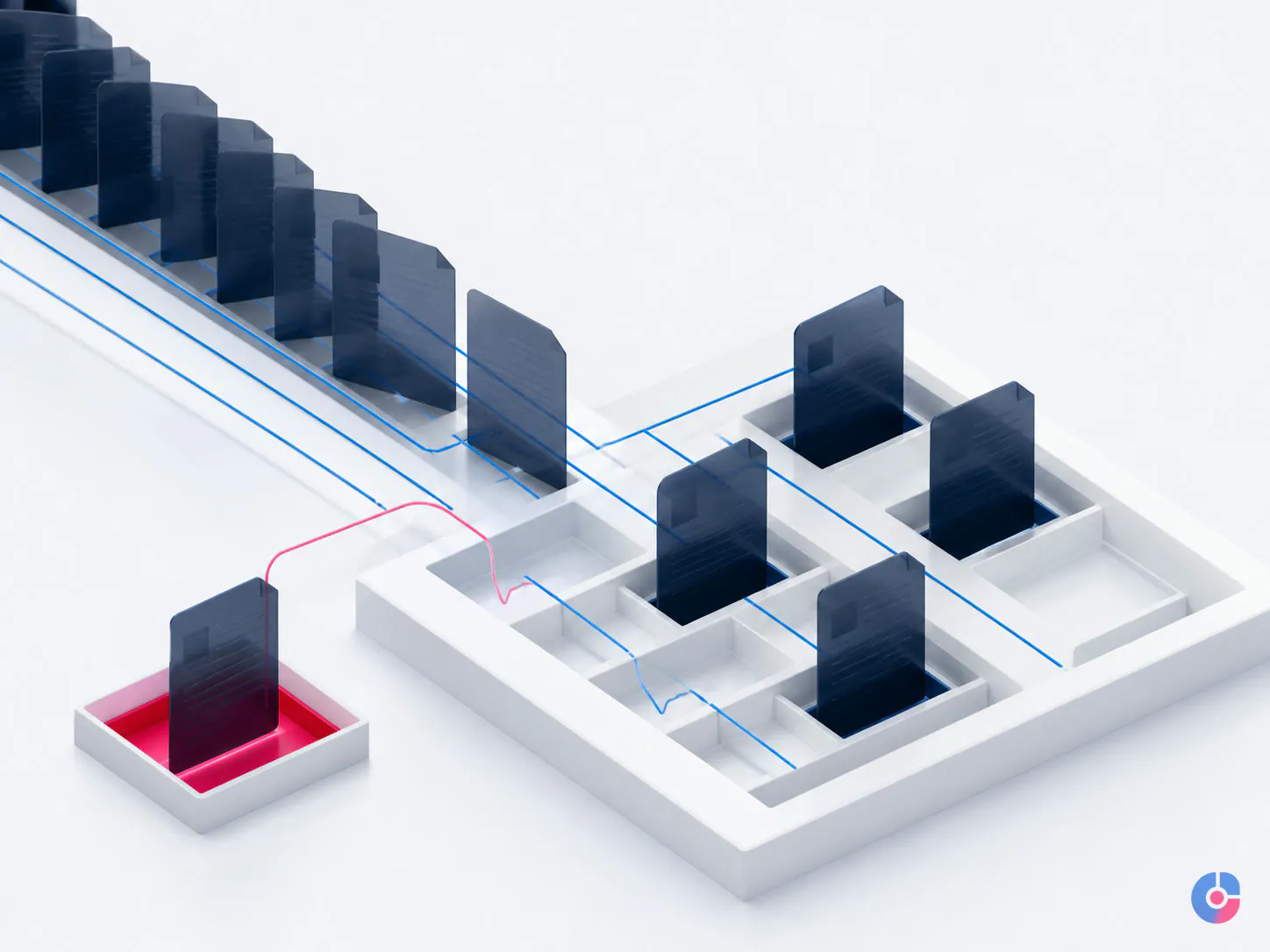
A request for access follows a timestamped lifecycle
For a US HIPAA-covered client, an individual’s right-of-access request is not treated like general correspondence. The request log captures when and where it was received, because internal forwarding time does not reset the applicable clock.
- Register receipt. Record the request, channel, requester, date and time, record holder, stated scope and assigned owner.
- Verify identity and authority. Follow the client’s reasonable verification procedure for the individual or personal representative without adding an unauthorised barrier.
- Confirm scope. Identify the designated record set, dates, services, exclusions requested, recipient and preferred form or format.
- Determine route and review. Apply the client’s approved rules for direct access, third-party direction, legal or specialist review and any grounds for partial or full denial.
- Locate and quality-check. Produce the authorised record set, reconcile pages or files, check patient identity and remove material only through an approved rule.
- Apply fee rules. Calculate only the fee authorised by the governing law and client policy, with notice or estimate where required.
- Deliver securely. Use the agreed form, format and recipient route, record dispatch and retain appropriate evidence.
- Close or escalate. Log fulfilment, unresolved items, approved extension or written denial process as applicable.
HHS Office for Civil Rights currently states in its HIPAA right-of-access guidance that a covered entity must act on an individual’s request no later than 30 calendar days after receipt. If it cannot act within that time, HHS describes one extension of no more than 30 additional calendar days, provided the individual receives a written reason and completion date within the initial period. HHS calls 30 days an outer limit and encourages faster access.
That federal statement is not the only timer a client may face. State law, another program, contract or client policy may require a shorter response or different process. OVELITHUB confirms the governing rule and escalation dates with the client’s privacy or legal owner before operating the queue. The page is not legal advice.
The detailed guide to handling medical records requests is available for teams still designing the lifecycle.

Privacy controls are part of the workflow, not a reassurance line
Where OVELITHUB is a business associate and the work requires protected health information (PHI), the applicable service and business associate agreements are executed before PHI access. HHS explains in its official business-associate guidance that covered entities may disclose PHI to a business associate when satisfactory assurances are established in a contract or other written arrangement. The agreement defines permitted and required uses, safeguards, incident duties, subcontractor obligations and termination handling.
The operational model uses named accounts inside the client’s EHR, document system, secure fax or portal; minimum-necessary permissions under the client’s policy; multi-factor authentication where supported; approved devices and connection methods; audit logging; session controls; and documented incident escalation. Work is assigned so the administrator sees only the locations, queues and record functions needed.
No local record copies are part of normal production. Printing, downloading, clipboard use, removable media, screenshots, personal email, consumer file sharing and unapproved AI tools are prohibited or technically restricted according to the client’s environment. Temporary files supported by an approved workflow follow a documented location and disposal process.
Offboarding names the person, systems, roles, removal authoriser, access-removal time, session revocation, token or device action, queue transfer and confirmation owner. “Account disabled” is not enough when portal access, group membership, shared links or remote sessions remain.
Retention and destruction follow the schedule the client owns
There is no responsible universal sentence such as “keep every medical record for seven years.” Retention varies by jurisdiction, record type, patient age, provider type, payer or programme obligation, litigation or investigation hold, contract and other applicable rule.
HHS states that the HIPAA Privacy Rule itself does not prescribe medical-record retention periods; HHS notes that state laws generally govern duration and that PHI must remain appropriately safeguarded for however long it is maintained, including through disposal. A practice therefore verifies its schedule against current official state, federal, national and professional requirements with the appropriate owner.
OVELITHUB maintains the approved schedule; it does not decide the legal period. The schedule records record class, jurisdiction, trigger event, minimum period, source authority, version date, owner, hold process, storage location, review date, approved destruction method and evidence required.
Disposition is a controlled event. Before destruction, the owner checks retention expiry, legal or audit holds, duplicate or master status, approval authority and destruction scope. Afterward, the register records what class and range were destroyed, method, date, authoriser, provider or system evidence and exceptions. No administrator bulk-deletes a record set because a spreadsheet date has passed.
A backlog is cleared without sacrificing the live queue
The first measurement separates unindexed intake, unmatched documents, incomplete chart-preparation items, open release requests, outside-record requests, scan backfile and retention-review work. Each group is aged from the relevant event and sampled for complexity.
Live work is protected first. Today’s intake and legally or operationally urgent items have dedicated capacity so the backlog does not grow while old work is cleared. A separate backlog queue has a starting inventory, type mix, batch size, quality sample, weekly capacity and estimated completion range.
A scanning backfile is a project with an end state. Before production, the team defines source-box or file inventory, preparation, separator rules, scanner settings, page orientation, blank-page handling, image-quality checks, patient matching, indexing, reconciliation, exception handling, custody, temporary storage and authorised disposition.

Weekly burn-down reports opening backlog, received additions, completed items, rework, sampled accuracy, unmatched count, oldest age, client holds and revised completion range. A rising live queue triggers capacity or scope action before the project claims success.
Records work stays inside your EHR and approved document routes
OVELITHUB uses the client’s EHR document-management module, work queues, secure fax, portal, archive and request-tracking functions where available. This preserves patient matching, timestamps, version history, permissions, audit events and clinical routing. Exporting records to run an unofficial parallel tracker increases custody and reconciliation risk.
The access matrix distinguishes intake, index, route, view, amend metadata, release preparation, release approval, download, print, retention action and administration. One role does not automatically receive every capability. Higher-risk actions can require a second person or client approval.
System fit is tested in a non-production or supervised workflow where available. The team confirms duplicate detection, document correction, merge restrictions, break-glass or sensitive-record handling, portal delivery evidence, audit-log availability and session behaviour before scale.
The assessment turns queue anxiety into a controlled work plan
OVELITHUB reviews four representative weeks where available, including request logs, fax or portal intake, index exceptions, pre-clinic work, ageing, system roles, current retention schedule and available audit evidence. The work is an operational assessment, not a legal compliance certification.
The report shows request and intake volume by type, current and agreed turnaround, backlog by age, unmatched and rework patterns, live-versus-project capacity, access-control questions and three indexing changes with the largest observed effect. It also proposes the first bounded queue, sampling method, client decisions and stop conditions.
The team does not promise to clear an unknown backlog by an arbitrary date. It counts the inventory, tests throughput and quality on a representative batch, then gives a completion range with assumptions.
Measure custody, turnaround and backlog together
A records function is controlled when the clinic can show what arrived, where it was indexed, who accessed it, which request clock applies and how disposition was authorised. The assessment makes those controls visible before work moves.
Request a records backlog assessment, email support@ovelit.com, or call +880 1707-510532. Browse all digital services for adjacent clinic support.
Keep reading
Related insights

What a Remote Billing Assistant Does
Claims get submitted and then forgotten. See how a remote billing assistant works eligibility, denials and AR follow-up to protect practice revenue.

How to Improve Patient Scheduling
Unanswered calls and no-shows quietly cut clinic revenue. See how to redesign scheduling and add remote support that fills the diary without…

Prior Authorization Support Services Guide
Prior authorisation delays treatment and stalls revenue. See how to run auth as a tracked queue with owners, deadlines and clean clinical…
Next step
Want this done rather than explained?
Tell us what needs doing and by when. You get a scope, a price range and an honest view of whether this is the right work for you at all.
- You send the brief A few lines is enough. No form fields you have to guess at.
- We reply in one business day With questions if we have them, and a range if we do not.
- You decide, not us No retainer to talk. If it is not our work, we say so.
Ask about BPO Services
We use what you send to answer you. We do not sell it, and we do not add you to a list.