

Web & data
The Role of a Digital Business Launch
A digital business launch is more than a website going live. See the eight systems that must exist on day one, and what happens when they do not.

Your new website is live. The first enquiry arrives, but the form sends it to an address nobody monitors. A second visitor tries to buy and meets a payment configuration error. Advertising begins on Monday; conversion tracking is still waiting for approval. At the end of the quarter, you know what you spent but cannot reconstruct which activity produced a customer.
That is a website launch, not a functioning digital business launch. A business is ready to launch online when it can attract the right person, explain the offer, take and record an enquiry or order, respond, deliver the next step and measure the route from first visit to commercial outcome.
A launch does not need to be complete. It needs to be complete enough to measure. Features, channels and automation can wait; ownership of the first customer journey cannot.
A launch is not a launch date
The public date matters because it coordinates work. It does not prove operational readiness. Readiness is a set of tested connections: domain to site, site to form or checkout, form to record, record to owner, owner to response, transaction to fulfilment, and each important step to measurement.
Treat launch as a state with acceptance evidence. For every route, name an owner, run a realistic test and preserve the result. If the company cannot demonstrate what happens after a visitor selects the primary action, the route is not ready even if every page has been approved.
The eight systems that must exist on day one
| System | Minimum day-one purpose | Ready test |
|---|---|---|
| 1. Offer and identity | Name the buyer, problem, offer, price logic and recognisable visual system | A target buyer can explain what is sold and the next step |
| 2. Website | Explain, prove and earn one primary action on each important page | A phone user completes the main journey without internal guidance |
| 3. Domain and business email | Provide controlled web and communication addresses | Ownership is documented; sending, receiving, renewal and recovery work |
| 4. Payment or enquiry capture | Accept the commercial action and give accurate confirmation | A test order, booking, call or form reaches the correct destination end to end |
| 5. Analytics and conversion tracking | Record agreed events without collecting data blindly | The test journey appears once, with the right source and event |
| 6. Lead or customer record | Give every enquiry or order one controlled home | The record has source, status, owner, consent context where applicable and next action |
| 7. Support channel | Give customers a monitored route for questions and problems | A test request receives an acknowledged, owned response through the fallback plan |
| 8. Content and acquisition plan | Create the first relevant demand and a learning schedule | Each activity has an audience, page, budget or effort, owner and measure |
Each system needs a person, not merely a tool. “The CRM sends an alert” does not answer who calls the lead. “The agency manages ads” does not answer who approves spend or fixes the page. Put one accountable name beside every ready test and one deputy beside customer-facing work.
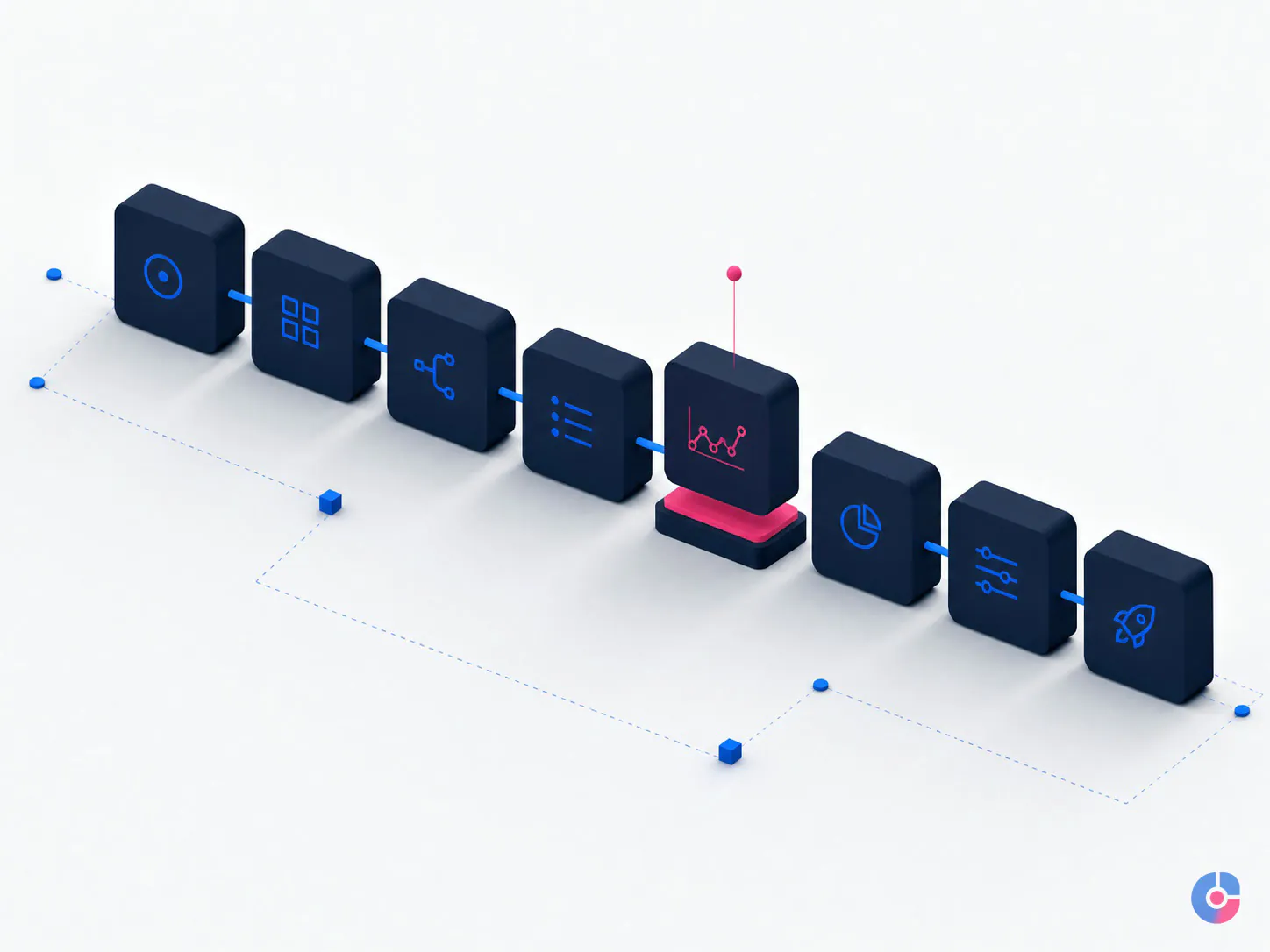
The ordered launch sequence
- Decide the business. Fix the buyer, offer, pricing logic and primary conversion before visual production.
- Build the identity layer. Establish the minimum reusable brand, domain and communication system.
- Create the website and transaction route. Build the shortest honest path from question to order or enquiry.
- Install measurement before traffic. Define events, configure lawful collection and test the full route.
- Assign the record and response. Give every lead, order and support request an owner, status and fallback.
- Run the first 90 days of demand. Use controlled acquisition and a weekly review to learn and improve.
The order prevents expensive rework. You can overlap work after the dependencies are clear, but do not approve a site structure before the offer, or buy traffic before the destination and measurement are proven.
Sequence 1: decide what the business is before designing
Write one page answering: Who is the first useful customer? What costly, urgent or valuable problem do they recognise? What exactly can they buy? What determines the price? What evidence reduces their risk? What single action should they take now? Name exclusions too. A website cannot resolve an offer that its owners have not decided.
Choose a primary conversion appropriate to the sale: buy, book, start a trial, request a quote, submit a qualified enquiry or call. Do not give six equal actions to avoid making one decision. Secondary actions can support people who are not ready, but the team must agree what counts as commercial progress.
This work is inexpensive while it is a document. It becomes costly after copy, layouts, integration and campaigns embody conflicting assumptions. If several offers serve different buyers, prioritise a launch route and phase the rest.
Sequence 2: build the minimum identity layer
The launch identity needs a viable name and domain, a logo system that remains legible at small sizes, a controlled colour and type set, basic image direction, written tone, and reusable templates for the channels you will actually operate. Record licences for fonts, images and other assets. Keep editable masters under company-controlled access.
Do not spend the validation budget on an elaborate identity universe before demand exists. You need enough consistency for a visitor to recognise the same business across the advert, website, confirmation and support message. Deeper positioning and identity development can follow evidence; the companion guide explains how to build a brand identity without turning this launch plan into a design manual.
Secure the domain in the organisation’s account, document renewal and recovery, and create role-based addresses such as sales or support where continuity matters. Personal inboxes can hide customer history when a founder is unavailable. Test messages in both directions and confirm the website’s automated notices arrive as intended.
Sequence 3: build the website and one action it must earn
Start with the minimum page set that removes risk from the primary decision. Most launches need a clear home page, offer or service detail, proof, about or trust information, contact or transaction route, required policies, and customer support information. Add pages because a buyer has a distinct question, not because a competitor has a larger menu.
Every page needs one main job and a truthful next-step expectation. If the visitor submits a form, say what information is required, who will respond and through which channel. If they pay, show a reliable confirmation and describe the next fulfilment step. Error states, validation, duplicate submissions and unavailable inventory need deliberate behaviour.
Test on representative phones and connections, with keyboard navigation and real content. Agree performance and accessibility acceptance criteria suited to the site and applicable duties. Google’s current Core Web Vitals guidance provides measurable field-performance definitions; it is more useful in a specification than the word “fast.” Obtain legal and specialist advice for privacy, accessibility, consumer, payment, tax and sector requirements in each market served.
If you already have a designer and “only need the site,” assign the integration work explicitly. Someone still owns content structure, forms, payment, analytics, CRM, consent, email delivery, security, quality assurance, launch and support. The guide to choosing a web development company helps evaluate that scope.
Sequence 4: install measurement before traffic
Measurement begins with decisions, not a tracking code. Write the questions the first 90 days must answer: Which audience reaches the relevant page? Which route produces a qualified action? Where do people stop? Which source produces customers rather than raw leads? What does acquisition cost once refunds, invalid enquiries or cancellations are considered?
Turn those questions into a small event plan:
- page or content viewed where it represents meaningful intent;
- primary action started;
- form, booking, call or checkout completed;
- lead qualified, sale accepted or order paid in the system of record;
- refund, cancellation or invalid-lead status where it changes commercial interpretation.
Define the event name, trigger, properties, purpose, system and owner. Configure privacy and consent based on the business, jurisdiction and technology. Avoid sending sensitive form values into analytics by accident.
Then run one end-to-end test from a tagged source. Complete the action on a representative device. Confirm the website response, analytics event, advertising-platform signal where used, CRM or order record, notification, owner assignment and downstream status. Check that refreshing the confirmation page does not create another conversion.
“We will add analytics later” creates a permanent blind period. A later tool cannot recover source, behaviour or failed actions it never recorded. Archive test evidence and annotate the launch date, campaign changes, outages and tracking releases so early data can be interpreted.

OVELITHUB’s data analytics services can help define and validate this measurement layer. If you need the website, tracking and first demand programme scoped together, book a digital launch consultation.
Sequence 5: decide where a lead lives and who answers
Every lead needs one authoritative record. At very low volume, a disciplined spreadsheet can work: unique record, timestamp, source, contact, status, owner, next action and result. Protect access and change history. A CRM becomes valuable when several people, channels, reminders, permissions or lifecycle stages make a sheet unreliable.
Define statuses in plain language: new, attempted, connected, qualified, proposal or checkout, won, lost and invalid, adjusted for the business. Each status needs entry criteria, required fields and the next responsible role. Do not let “contacted” mean a sent email in one report and a conversation in another.
Set an internal response commitment based on operating hours and buyer expectation. Then design cover. Who monitors evenings or weekends, if anyone? What automated acknowledgement is honest? What happens during leave, outage or high volume? Which questions may support answer, and which require sales, finance, clinical, legal or technical escalation?
A shared support inbox needs an owner, categories, approved answers, identity checks where required, escalation and closure evidence. The guide to running email customer support covers the operating detail. The launch plan only needs to prove that an issue cannot disappear inside an unwatched mailbox.
Sequence 6: plan the first 90 days of demand
Do not ask one channel to prove the whole business. Use a limited paid test where you need controlled exposure and quicker message evidence, alongside useful content, partnerships, direct outreach or search work that can build more gradually. The mix depends on the audience, buying cycle, economics, regulation and internal sales capacity.
A new site should not budget the launch quarter on an assumption of immediate organic visibility. Search work needs discoverable pages, technical access, relevant content, links or reputation signals, and time for systems and people to find and evaluate it. Paid activity can produce traffic sooner but does not rescue an unclear offer, weak page or absent follow-up.
For each activity, document audience, promise, destination, spend or effort limit, start and stop conditions, expected signal and owner. Change one meaningful variable at a time where possible. Preserve the original page or message so later conclusions have a reference.
The deeper digital business launch strategy guide covers channel choices and experimentation. Here, the readiness rule is simpler: do not send demand into a route that has not passed the end-to-end test.
What usually breaks, and how to see it early
| Observed pattern | Likely question | Immediate check |
|---|---|---|
| Traffic without enquiries or orders | Is the audience, offer, page or tracking wrong? | Replay the journey; segment relevant traffic and inspect the primary action |
| Enquiries without follow-up | Did routing, ownership or capacity fail? | Reconcile submissions with records, notifications and first actions |
| Follow-up without records | Are conversations happening outside the system? | Sample inbox, phone and CRM activity against status rules |
| Records nobody reviews | Which decision was the report meant to drive? | Assign metric owners and record the next change, date and limit |
Run a 45-minute weekly launch review. Reconcile visits or reach, primary actions, valid leads or orders, response, progression, revenue where available, spend, customer issues and tracking health. Review by source and landing route. End with no more than a few decisions, each with an owner, effective date and evidence to watch. Do not optimise a tiny sample as though it were certainty; record what is signal, what is observation and what still needs data.

One launch partner or several vendors?
Multiple specialists can offer deeper expertise in a difficult discipline and let you replace one scope without moving the rest. They are a good fit when you have a capable internal launch owner who can sequence dependencies, resolve conflicting advice, control accounts and reconcile reporting. The founder or manager acting as integrator is doing real work; include that time and authority in the plan.
One partner reduces handoffs and concentrates roadmap, testing and reporting in one relationship. It also concentrates supplier risk and may provide less depth than a narrow specialist in one advanced channel. Require visible specialists, client-owned accounts, written scope, measurable acceptance and a practical exit.
OVELITHUB connects four pillars—Website Development, Digital Marketing, BPO Services, and Branding and Creative Design—for launch work across the USA, Europe and the Middle East. Its digital business launching services are appropriate when those joins need one roadmap; they are not a reason to avoid a specialist when the job is genuinely narrow.
Launch small, but launch measurable
Perfection delays evidence; incompleteness without measurement creates noise. Choose the smallest credible customer route, connect its eight systems, test it end to end and review the first 90 days against decisions you can make. Then add pages, channels and automation because the evidence justifies them.
Keep reading
Related insights

Shopify Store Support Services: A Guide
A Shopify store needs weekly upkeep, not occasional fixes. See the support tasks that protect revenue, who should own each, and what…

Shopify vs WooCommerce: Which to Choose
Shopify and WooCommerce both work. The difference is who carries the maintenance and where the cost lands. Compare both against your team…

How to Choose a Web Development Company
Choosing a web development company in the USA or Europe? Use these nine selection criteria to judge proposals, ownership terms and post-launch…