

Support and sales desks
24/7 Customer Support Team Services
Round-the-clock support staffed as a real rota, not a promise. Cut first-response time overnight and stop losing customers to the silent hours.
Bought under BPO Services From $350 per agent · live in 1 weeks

At 6:05 p.m., the last daytime agent signs off. A customer asks whether an order can still arrive before an event. At 9:40 p.m., another reports a failed login. Near midnight, a high-value prospect sends a pre-purchase question. By 8:00 a.m., the queue contains simple contacts that have aged into cancellation requests, duplicate messages and avoidable escalations.
A 24/7 customer support team is often sold as a badge. In practice, it is a rota: named people, defined authority, realistic concurrency, shift cover, quality review and a handover that keeps the customer’s history intact. Buying the badge without designing those parts creates an expensive overnight inbox.
Most businesses do not need the same live staffing at every hour. They need coverage during the hours when contacts actually arrive and when waiting changes the outcome. OveliTHub starts with the contact curve, then proposes full live coverage, extended hours with triage, or monitoring with escalation. If the smaller model protects the customer at lower cost, that is the one we will recommend.
The hours you are not answering can create tomorrow’s hardest work
An unanswered contact does not remain unchanged overnight. A customer may retry on another channel, submit a second ticket, abandon a purchase, contact a payment provider or arrive in the morning already frustrated. The daytime team then spends its first hours deduplicating, reconstructing and recovering rather than solving a clean original request.
The operational question is not “Do customers like fast replies?” It is more precise:
- Which contact reasons become materially harder after waiting?
- At which hours do those reasons arrive?
- What can a trained night agent resolve safely?
- What authority and system access does resolution require?
- What can wait until the correct specialist starts?
- What event genuinely justifies waking a client decision-maker?
A shipping-address correction before fulfilment cutoff may be time-sensitive. A general feature suggestion may not be. A payment outage needs fast escalation; a non-urgent account change can often wait behind an honest response-time notice. Coverage should follow consequence, not a marketing slogan.
Map the contact curve before buying coverage
Export at least a representative quarter from the helpdesk. Use the original creation timestamp, converted into the customer or operating time zone being analysed. Include weekday, channel, contact reason, priority, first response, first meaningful response, resolution, escalation, reopen, satisfaction where available and final owner.
Then:
- Group contacts by hour and weekday. Keep weekends and holidays separate; a single weekly average can hide them.
- Separate new demand from retries. Multiple messages about one unresolved issue should inform workload, but not be mistaken for independent demand.
- Tag consequence and resolvability. Identify what can be resolved from an SOP, what needs restricted authority, and what needs a specialist.
- Overlay current staffing. Mark the exact periods with no agent, thin cover or a single point of failure.
- Model service by band. Calculate arrivals, handling demand, concurrency, escalation, backlog and target response separately for each hour band.
- Repeat for peaks. Campaigns, releases, billing dates and seasonal events need their own curve.
Do not assume local helpdesk timestamps are comparable. Document daylight-saving changes and the source time zone. Also distinguish automated acknowledgement from a human response that advances the case; otherwise the curve may make unattended work look answered.
An illustrative contact curve
The table below is a hypothetical typical day, not an OveliTHub client result or market benchmark. The daytime desk operates 08:00–18:00. The point is the shape: two unattended peaks with a quiet middle, not flat demand.
| Local time | New contacts | Current state | Design implication |
|---|---|---|---|
| 00:00–02:00 | 3 | Unattended | Triage may be sufficient |
| 02:00–05:00 | 1 | Unattended | Monitoring and escalation |
| 05:00–08:00 | 9 | Unattended peak | Early live block or triage |
| 08:00–12:00 | 27 | Day team live | Backlog must arrive clean |
| 12:00–18:00 | 34 | Day team live | Normal daytime capacity |
| 18:00–21:00 | 7 | Unattended | Extended-hours block |
| 21:00–24:00 | 11 | Unattended peak | Live late shift |
In this example, adding live 18:00–24:00 and 05:00–08:00 coverage would cover the two peaks with 9 hours a day, or 63 seat-hours a week. Covering the entire 18:00–08:00 gap requires 98 seat-hours a week. The 35-hour difference may be justified by severity, service commitments or growth—but not by the shape alone.

Three coverage models and their honest tradeoffs
1. Full follow-the-sun live coverage. Customers can reach a trained agent at every hour. Separate shifts or regional teams carry the queue through 24 hours, with enough concurrent seats for each band. Agents resolve within approved scope; specialists remain on defined escalation. This is appropriate for material global demand, contractual response commitments, time-sensitive transactions or products whose failures cannot wait.
The base arithmetic is 168 staffed hours per week for one continuously occupied seat. That is not the same as one person or even exactly 168 paid hours. Breaks, leave, sickness, training, meetings, coaching, supervision and peak concurrency require additional capacity. The rota model must use the provider’s measured productive-hours assumption and show cover by interval.
2. Extended hours plus overnight triage. Live agents cover the late and early peaks. During the quiet middle, a smaller rota reviews incoming cases, resolves simple approved requests, protects urgent deadlines and prepares clean escalations for specialists. Customers receive a human answer where it changes the outcome; lower-risk cases wait for the correct owner.
This usually uses fewer seat-hours and more precise SOPs. It gives up immediate full resolution for cases outside the triage team’s authority. For many growing merchants and service firms, this is a more honest first purchase than a full live desk.
3. Overnight monitoring with defined escalation. No general live queue is promised. Alerts, priority channels or scheduled queue checks identify specified high-severity events. An on-duty person follows a decision tree, contacts the named responder when required and leaves non-urgent work for the morning shift.
This protects against a narrow set of costly events at the lowest staffing commitment. It does not provide a human conversation for ordinary contacts and must advertise the actual reply time clearly. Monitoring is appropriate when overnight demand is sparse and well-defined severity matters more than immediate service for every case.
For a transparent cost model behind these options, read how much a 24/7 support team costs. To see which rota matches your own timestamps, book a free consultation.
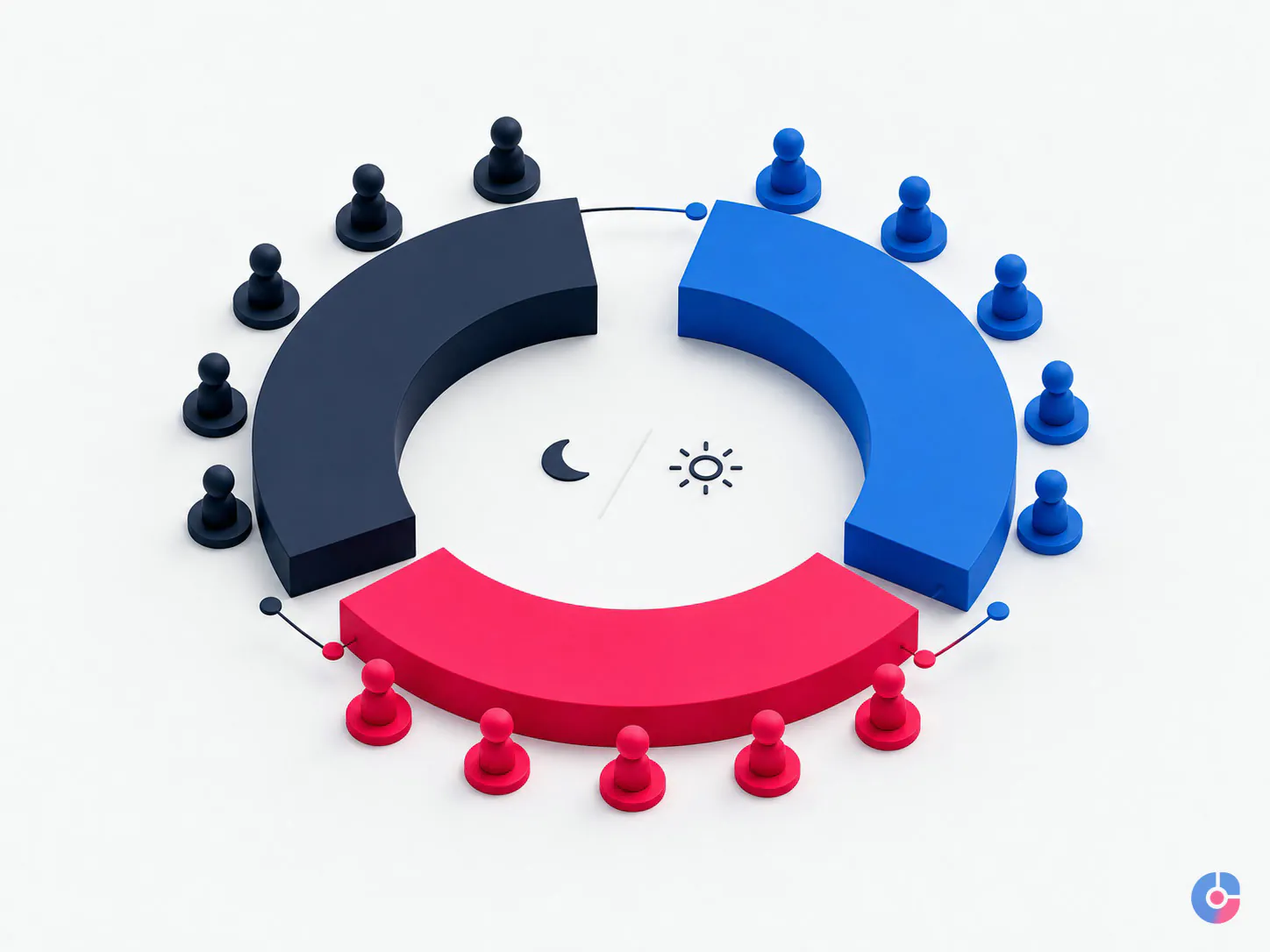
Shift change is where round-the-clock service fails
A night agent promises an update after checking a payment record. The morning agent sees an open ticket but not the promise and sends a generic reply. Another case receives two answers because both shifts assume ownership. A third waits because each person believes the other escalated it. To customers, these are not rota defects; they are one organisation behaving incompetently.
Every shift needs overlap or an explicit handover window and one authoritative artefact inside the helpdesk or approved operating system. Chat is not the system of record. The outgoing owner remains responsible until the incoming owner accepts the queue or the escalation rule transfers it.
The handover checklist
- Queue state: new, open, pending, waiting, escalated and breached cases by agreed definition.
- Named ownership: every active case has one next owner and due time.
- Customer promises: exact commitment, channel, timestamp and promised update time.
- High-risk cases: severity, business effect, evidence, action taken and next decision.
- Blockers: missing access, policy, specialist response or client approval.
- Duplicates and linked contacts: one primary record and the channels or cases consolidated into it.
- Workarounds: temporary instruction, approval source, affected scope and expiry.
- Known incidents: incident owner, status page or internal record, approved customer language and next review.
- Backlog plan: priority order, expected capacity and cases that cannot wait.
- Rota exceptions: absence, late arrival, reduced concurrency or replacement cover.
- System health: helpdesk, phone, chat, identity or integration issues affecting the shift.
- Acceptance: incoming shift confirms ownership and raises discrepancies before the outgoing shift closes.
Sample the handover itself. Measure dropped ownership, duplicated replies, missed promises and cases without a next action. A perfect night-resolution rate can still hide a morning backlog full of unusable notes.

What an OveliTHub night rota looks like on your side
You work with named agents assigned on a recurring rota, not an anonymous pool selecting the next available contact without product context. The same people learn your terminology, policies, customer types, failure patterns and escalation boundaries. A named supervisor owns the rota, attendance, overlap, quality sampling, coaching, cover and report.
The team works in your approved helpdesk and communication systems through named least-privilege accounts. SOPs, macros, knowledge sources and escalation rules are versioned. The client retains control of policy, authority limits, high-risk access and business decisions; OveliTHub operates the agreed shift and shows the evidence.
We have delivered 130+ projects and support businesses serving the USA, Europe and the Middle East. That experience informs rota design, but your timestamp export—not a generic regional claim—determines the proposed hours.
The general case for using an external provider instead of employing a local night desk belongs in our customer support outsourcing service. This page stays focused on how the hours are staffed and transferred.
Channels we can cover overnight
Email and tickets suit triage and asynchronous resolution because cases retain history and can move across shifts. Live chat deserves live staffing only during intervals with enough arrival volume or high-value purchase intent to justify it. Social inboxes can be reviewed on a scheduled cadence where public risk or direct-message urgency requires it. Phone needs explicit simultaneous-call capacity, routing, recording policy, quality review and enough demand to justify an occupied line.
A channel with two ordinary overnight contacts may be better served by an honest automated message stating the response window than by pretending an agent is immediately available. Channel strategy beyond the rota is covered under multichannel customer support.
Measure the night shift as its own operation
A 24-hour average can hide a strong day and a broken night. Segment measures by shift and one-hour or business-relevant bands:
- First meaningful response: time to a human response that advances the case, not an automated receipt.
- Resolution and escalation rate: cases closed within authority versus transferred, by reason.
- Backlog at day-team start: number, age, priority and required effort at the agreed morning timestamp.
- Promise reliability: customer updates delivered by the time stated.
- Handover defects: duplicates, dropped ownership, missing notes and unresolved discrepancies.
- Quality sample: accuracy, completeness, tone, policy, record updates and escalation decisions.
- Customer satisfaction: segmented by shift, reason and channel with response counts visible.
- Coverage adherence: planned versus staffed intervals and any concurrency shortfall.
Keep definitions and time zones stable. Pair rates with numerator and denominator, especially on a low-volume night shift where one case can swing a percentage. Report what waited deliberately as well as what failed to move.
Escalation rules stop unnecessary 4 a.m. calls
Control comes from pre-approved boundaries. Define severity from impact and urgency, not customer emotion alone. The example below must be adapted to the product, law, contract and actual authority.
| Tier | Night-agent action | Authority | Client contact |
|---|---|---|---|
| Routine | Resolve from approved SOP or set accurate expectation | Approved account, information and low-risk service actions | Include in normal report |
| Time-sensitive | Protect deadline, gather evidence, use bounded remedy | Refund, credit, reship or change only within written limit | Notify designated channel; call only if threshold says so |
| High severity | Open incident, use approved containment, preserve evidence | No speculative public statement or unapproved system change | Call named responder within defined minutes |
| Restricted | Acknowledge, secure the record and wait for authorised owner | No action on legal, safety, sensitive-data or exceptional financial request | Follow special escalation path |
For every row, name the decision owner, contact order, retry rule, evidence required, fallback if nobody answers and approved customer language. Test the call tree. An escalation document that contains former employees or silent phones is not a control.
Onboard the night rota in four weeks
Week one: contact audit and scope. Analyse timestamps, reasons, handle demand, backlog and current service. Map systems, permissions, policies, severity and client contacts. Agree the coverage model and baseline measures.
Week two: knowledge and control build. Create or revise SOPs, macros, authority limits, handover, incident paths, data handling and the quality rubric. Provision named accounts and test integrations. Sample agents against realistic cases.
Week three: shadow and reverse-shadow. OveliTHub agents observe the client team, then handle cases while an experienced reviewer watches. Run shift-change simulations, including a missing approver and an absence. This is where training meets real variation; expect questions and correct them quickly rather than assuming classroom accuracy will transfer automatically.
Week four: controlled live coverage. Start the agreed intervals with daily sampling, daily handover review and an accessible escalation owner. Compare the new band-level metrics with the baseline. Expand authority or hours only after evidence supports the change.
Recruitment detail is a separate buying question. If you need role requirements and selection criteria, see customer care representative staffing.
Get your contact curve reviewed
Export the last quarter’s contact creation timestamps, weekdays, reasons, first meaningful response, resolution, escalation and channel. Remove or protect personal data before sending and include the time zone. We will return a proposed coverage model, seat-hour arithmetic, handover design, escalation boundaries and the assumptions that drive price.
Set at the service, not here
The terms every BPO services engagement runs on
The price, the ownership and the renewal terms are the same whichever offering you buy, which is why they are published once rather than restated on every page.
- Starting price
- From $350 per agent per month, in US dollars. 4 hours a day, 5 days a week, one channel, documented SOPs and a monthly QA report. Live in 2 weeks
- Channels
- Email, live chat, phone, social inboxes, CRM and back-office systems
- Coverage
- Hours are stated per desk and written into the agreement, including which of your working days are covered from UTC+6
- Data protection
- UK GDPR Article 28 processor agreement, Standard Contractual Clauses and the UK IDTA where data leaves the UK or EEA
- Quality
- Monthly QA scoring against a rubric you approve, with the sampled tickets attached
- Tooling
- We work inside your helpdesk and your CRM. No forced migration to a platform we own
Bought together
Also in support and sales desks
Cold Email Support Services for B2B
Cold email run on protected domains with proper authentication, warm-up and list hygiene. Reach the primary inbox and keep your main domain…
What it coversAmazon Store Assistant for Sellers
A trained Seller Central assistant for listings, cases, inventory and account health. Protect your Buy Box and get your evenings back from…
What it coversTravel Agency Back Office Support
Offshore back office support for bookings, ticketing queues, supplier reconciliation, refunds and itinerary admin. Request a travel back office review.
What it coversNext step
Tell us what you need from 24/7 Customer Support Team Services
Volume, hours and the systems it has to run in. The first reply carries a scope and a figure rather than a request for the basics.
- You send the brief A few lines is enough. No form fields you have to guess at.
- We reply in one business day With questions if we have them, and a range if we do not.
- You decide, not us No retainer to talk. If it is not our work, we say so.
Ask about 24/7 Customer Support Team Services
Priced per agent per month. The written procedure comes before the first agent is hired, so say what the work actually is.
We use what you send to answer you. We do not sell it, and we do not add you to a list.