

BPO & back office
How to Reduce Operational Cycle Time
Most operational delay is queue time, not work time. See how remote operations support cuts the waiting, the rework and the chasing between steps.

A quote may require forty minutes of useful work and still take six days to reach the customer. The remaining time is not careful execution. It is waiting for complete measurements, sitting in an estimator’s queue, returning for a missing supplier price, waiting for approval and resting in a draft folder after approval.
That comparison changes how to reduce operational cycle time. If hands-on work takes minutes while elapsed time takes days, asking the busy step to work faster attacks a small part of the delay. The larger opportunity is the queue, handoff, exception and rework between steps.
Remote operations support earns its place by owning that connective work: intake, status, chase, exception evidence and the next-action record. It should not be purchased as generic extra hands. Start with one measured process and a specific wait to remove.
The number that changes the conversation
Touch time is the time people or systems actively work on a case. Elapsed time is the clock time from the defined start to the defined finish. The difference contains necessary waiting, planned service windows and avoidable delay.
Use an illustrative quote-to-customer case:
| Stage | Illustrative touch time | Illustrative wait | Observed cause to test |
|---|---|---|---|
| Validate request | 8 minutes | 14 hours | Shared inbox has no intake owner |
| Collect missing input | 7 minutes | 2 days | Question sent without a deadline or escalation |
| Build quote | 25 minutes | 1 day | Estimator queue ordered by message arrival |
| Approve and send | 10 minutes | 2 days | Approver sees no ready-for-review queue |
These figures are a hypothetical teaching example, not an OVELITHUB client result or industry benchmark. Their purpose is to expose the intervention logic. The work itself totals less than an hour; the clock is governed by intake ownership, missing input and approval visibility.
Calculate both measures for 20 to 30 recent cases if volume allows. Use the median, distribution and oldest cases rather than one average. Mark pauses caused by the customer, regulation or a deliberate batching policy separately from internal avoidable wait. The team needs facts, not blame.
Map the process before buying anything
Put the people who perform, receive and approve the work in the same working session. Include one frontline operator, upstream input owner, downstream recipient, system owner and process owner. The process on a slide is often different from the process people actually use.
Choose a precise start and end: “complete quote request received” to “approved quote delivered”, not “sales process”. Walk one ordinary case and one difficult case. For every step, capture:
- step and purpose;
- trigger and required input;
- person or system responsible;
- active touch time and elapsed wait;
- queue order and service target;
- system, file and evidence used;
- decision and authority required;
- handoff condition and receiving owner;
- common exception and rework route;
- definition of accepted completion.
Do not spend months making a perfect diagram. A focused process with recent cases can usually be made visible in a short workshop plus evidence review. The goal is to find the first controllable delay, not declare an enterprise transformation.
Two findings recur: a step exists because an old system or person once required it, and a handoff lasting days has no owner. Delete, combine or redesign before staffing it.
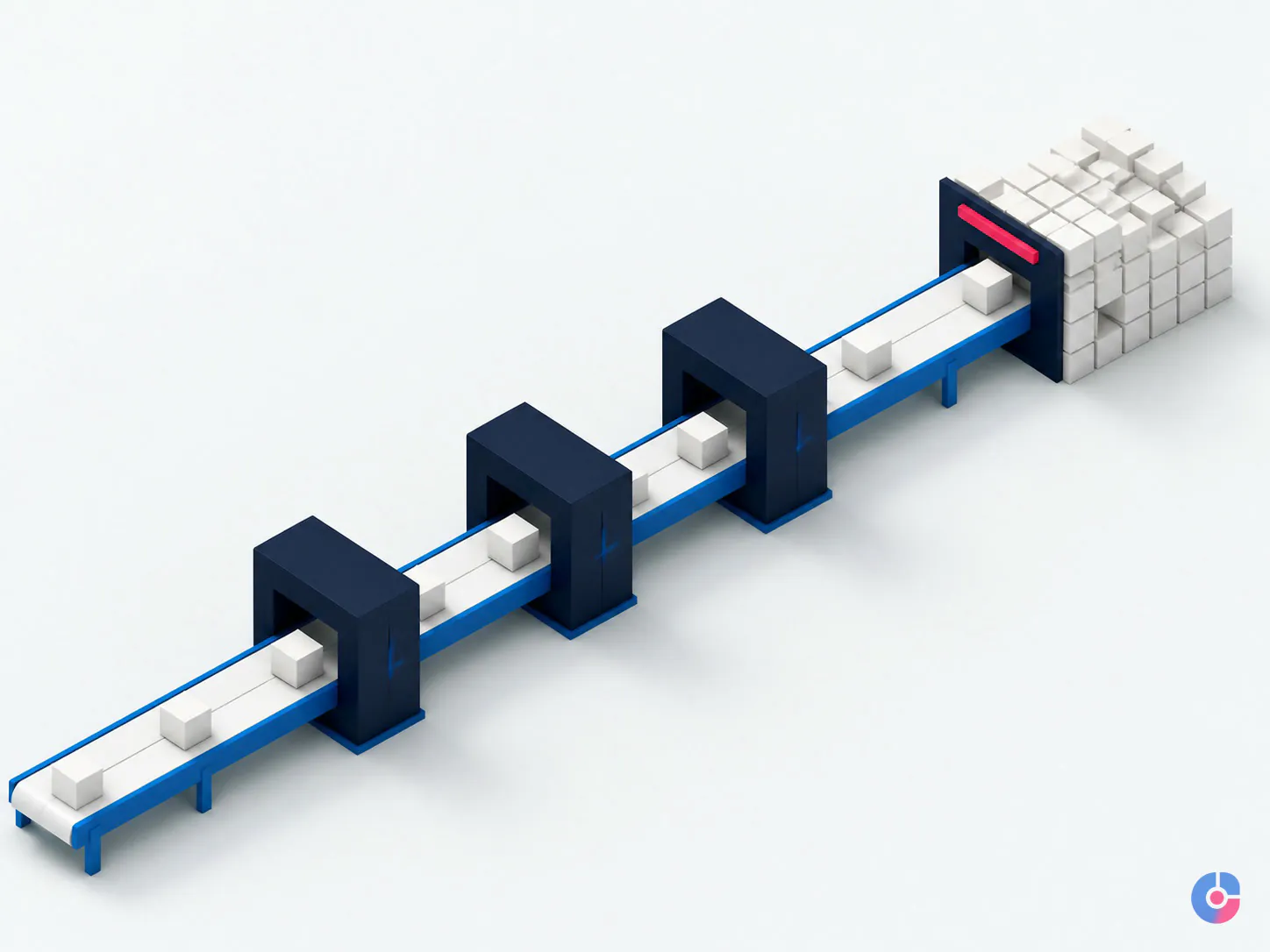
The four places time disappears
Queues
Symptom: work is ready but nobody has begun. There may be no visible order, capacity limit or oldest-case alert. Measure time from ready state to start, queue count and oldest age. Fix intake, prioritisation, capacity visibility or the constraining step—not only worker speed.
Handoffs
Symptom: the sending person thinks work has moved; the receiving person does not know it is ready or returns it for missing input. Define the entry criteria for the next step, receiving owner, notification and acknowledgement. A sent email is not an accepted handoff.
Exceptions
Symptom: routine cases move while anything unusual waits for one expert. Log exceptions for two weeks. “Every case is different” often becomes a small number of recurring categories once cause, evidence and decision are recorded. Write rules for safe categories and preserve expert review for the rest.
Rework
Symptom: a case revisits a completed step, but the second effort is counted as normal volume. Rework consumes capacity more than once and can hide across teams. Record original defect, detection point, return stage, correction time and root cause. Do not publish a first-time-right rate until the process defines what constitutes rework.
These causes interact. A poor handoff creates an exception. The exception enters a specialist queue. The specialist corrects the record, and the rework makes their queue longer. Improve the first defective point, not only the final backlog.
What a remote operations team should own
Intake and triage
Done: every eligible request is captured once, checked for minimum input, classified, timestamped, prioritised under written rules and assigned to the next owner. Invalid or duplicate input enters a visible exception, not a private inbox.

Status keeping and chasing
Done: current stage, owner, last evidence, next action and due time are visible. The support team follows the stated cadence, captures replies and escalates non-response. “Chased” without a response deadline is activity, not control.
Exception handling
Done: the team recognises the exception category, gathers required evidence, makes only authorised decisions, routes the rest with a recommendation and tracks the answer. The rule owner receives recurring causes for prevention.
Document and record preparation
Done: the approved source is transformed into the required template or system fields, validated, linked to evidence and presented for the correct approval. The operator does not interpret contracts, clinical facts or financial policy outside scope.
Supplier and internal follow-up
Done: the named information or action is requested from the right party with context and deadline; reply is stored in the shared record; commercial or contractual changes escalate.
Reporting assembly
Done: fixed sources and definitions feed a repeatable pack on schedule, with gaps and anomalies flagged. The process owner interprets performance and decides changes.
Daily queue review
Done: new arrivals, oldest items, deadlines, capacity, blocked cases and reassignment decisions are reviewed against the service rule. Work does not become urgent only when somebody complains.
Exception handling with written decision rules
Use an exception log with:
- case and date discovered;
- standard path and point of departure;
- category and suspected cause;
- customer, financial, regulatory or service risk;
- evidence attached;
- decision required, authority level and named owner;
- safe holding action and response deadline;
- resolution, rework time and approval;
- preventive change, owner and completion date.
Then write limits: the remote team may correct a missing internal reference from the signed source; it may not alter price. It may offer a reschedule inside approved availability; it may not waive a fee. It may request a required document; it may not reinterpret the contract.
If every exception escalates, the team adds noise. If none escalate, it is probably making unauthorised assumptions. Review the middle: categories that can safely become rules after evidence and approval.
What to automate instead of staffing
Automation fits deterministic, repeatable transfers: receipt acknowledgements, status notifications, routing by controlled values, due-date reminders, recurring report refreshes, field validation and data movement through supported integrations.
People fit ambiguous input, exception diagnosis, customer-facing explanation, cross-source reconciliation and judgement under defined authority. The useful design is often automation for the normal path and a trained support queue for exceptions.
Map first. McKinsey’s report on execution pitfalls in automation programs warns that going directly into technical development can automate inefficient or obsolete processes, and argues for process and organisation redesign alongside automation. That does not make every workflow a consulting project. It supports a practical rule: remove obsolete steps, clarify handoffs and define exceptions before encoding them.
Automating a reminder does not help when the status field is unreliable. Routing rules fail when categories overlap. An API moves the wrong value faster when source ownership is unclear. Prototype on a bounded process, preserve auditability and define what happens when the automated step rejects or fails.
Measure the intervention properly
Baseline before any staffing, automation or policy change. Use the same start, end, eligibility and exclusions afterward:
- Elapsed time per case: clock time from valid intake to accepted completion, with distribution and age.
- Touch time: active effort by step, used to distinguish labour from wait.
- Completed within target: eligible cases meeting the process’s stated service time, not a borrowed benchmark.
- Queue age: count and oldest age in ready, blocked and exception states.
- Rework rate: cases or outputs returning to a prior completed step under a published definition, plus rework time.
- First-time-right: eligible cases accepted without correction, using the agreed quality criteria.
- Weekly volume: valid arrivals and accepted completions, shown with opening and closing backlog.
Segment by work type, client, channel or exception. A faster median can coexist with a worsening oldest-case tail. Higher completions can come from easier mix. Annotate volume, staffing, policy, source and system changes.
Do not claim that remote capacity caused every improvement. The intervention may combine clearer intake, delegated authority, better visibility and additional trained time. The purpose is to make the changed mechanism and result visible.
OVELITHUB can apply this method through remote operations support. Book a free consultation for a process walk-through based on real cases.
Two illustrative examples across industries
Illustrative construction quote-to-order flow
A fictional contractor receives 25 quote requests in one week. The map shows measurement attachments missing from six, supplier prices chased through personal email, and approved quotes waiting for the sales owner to notice a draft. These figures are illustrative only.
A support coordinator takes intake ownership, checks the required-document list, returns incomplete requests the same day under the agreed rule, creates supplier requests from a template, records due dates and places ready quotes in an approval queue. The estimator retains technical quantity and price work; the commercial owner approves and sends.
Measure valid-intake-to-send time, incomplete-intake rate, supplier-response age, approval-queue age and quote corrections. Do not infer revenue improvement until the business tracks customer response and won work under consistent conditions.
Illustrative clinic patient-onboarding flow
A fictional clinic maps new-patient request to registration-ready appointment. Active registration work takes a short period, but cases wait for insurance images, demographics, referral information and an unanswered eligibility exception. Again, these are illustrative operating mechanics, not a client case study.
A trained support team checks the approved intake, requests missing non-clinical information through the authorised channel, runs the eligibility workflow, records the response reference and routes coverage, authorisation or clinical questions to named owners. Scheduling and clinical staff retain decisions within their professional scope.
Measure valid-intake-to-ready time, missing-field rate, eligibility-exception age, rework after appointment and privacy or access incidents. Applicable healthcare law and payer rules govern design; speed does not override patient or clinical safeguards.

Governance so improvements do not decay
Assign one end-to-end process owner who can resolve conflicts between steps. Individual department owners still manage their work, but one person owns elapsed outcome and the handoffs between them.
Hold a short weekly review of:
- arrivals, completions and ending backlog;
- oldest ready, blocked and exception items;
- target performance and the slow tail;
- rework cases and original defect point;
- top exception categories and decision delays;
- one rule, form, training or system change with owner and date.
Version process rules and metric definitions. Train changes before their effective date. Re-map quarterly or after a material product, system, contract or volume change. If the team quietly adds a workaround, put it on the map and decide whether to formalise or remove it.
Managed delivery can provide this operating lead when the client cannot supervise the queue directly; compare managed remote teams. The detailed build sequence sits in how to set up a remote operations team.
The 90-day plan
Weeks 1–2: select one process, define boundaries, gather recent cases, measure touch and elapsed time, map steps and identify queue, handoff, exception and rework causes. Choose the first controllable constraint.
Weeks 3–6: hand over valid intake, status and chasing under written rules. Provision named access. Review every early exception and sample routine output. Keep the baseline unchanged.
Weeks 7–10: approve decision limits for recurring exceptions, introduce the exception log and weekly report, and automate only stable deterministic steps. Give the team ownership of the daily queue review.
Weeks 11–13: compare elapsed time, queue age, target completion, rework, volume and old cases with baseline. Interview the people upstream and downstream: did they receive better input, or merely more notifications?
At day 90, continue if the target wait shrank without shifting defects or creating hidden work. Expand to one adjacent process only after the first has an owner, stable rules and a reproducible report.
Next step
Choose one process whose elapsed time matters. Bring 20 recent cases, system timestamps and the people on both sides of the slowest handoff. That is enough to find a narrow starting point.
Keep reading
Related insights

How to Research a Prospect Before a Call
Reps skip research because it is slow, then open with nothing. See how to standardise account research so every conversation starts from…

Setting a Data Entry Accuracy Rate
Buy an error rate and a turnaround time, not a headcount. How to specify, staff and audit a remote data entry team…

Remote Employees for Non-Technical Roles
Admin, support, research and coordination move remote easily. See which non-technical roles transfer well, which resist it, and how to tell them…