

Support & sales
Data Enrichment Services for B2B Sales
A list of names is not a pipeline. See how B2B data enrichment fills the fields reps actually use, what it costs, and where automated tools fall short.

A CRM contains 2,000 records with a company name and an email address. Job titles are missing. Employee counts are inconsistent. Nobody knows which accounts use the technology the offer depends on. Sales representatives open each website, guess whether the contact has authority and spend more time researching than selling. Meetings arrive occasionally, but the team cannot explain cost per meeting because it cannot distinguish targeting failure from contact failure.
A list of names is not a pipeline. Data enrichment makes an existing record more usable by adding defined fields from permitted sources. Its value is not the number of blanks it can fill. Its value is whether the new information changes whom a representative prioritizes, which message they send or whether they should work the record at all.
That distinction matters because enrichment is usually sold through coverage. “We match 90%” sounds precise while saying nothing about the fields your workflow needs, their accuracy, their source or their age. Buy enrichment as a field-level accuracy and maintenance problem, not a database-decoration exercise.
What data enrichment actually adds
Enrichment appends or updates attributes on records you already hold. Given a company domain and contact identity, it may return an industry category, employee-count band, role, location, public company profile, technology signal or business contact route. The input record must already exist and be in scope.
Keep the neighboring activities separate during vendor conversations:
- Prospect research or list building finds new accounts and people that were not already in your system.
- Enrichment fills specified fields on existing records.
- Verification checks whether a specific value is current or correct.
- CRM data entry and hygiene creates, maps, deduplicates and maintains records inside the system.
- Campaign execution selects, messages and follows up with contacts through a lawful outreach process.
A service may combine them, but the scope, accuracy measure and legal basis should remain visible. Enrichment cannot repair a list of companies that never fit the ideal customer profile, and it cannot make a weak offer relevant.
Firmographic, technographic, contact and intent fields
Firmographic fields describe an organization: industry, employee band, headquarters, operating region, ownership or revenue band. Registered address and legal name may be directly sourced; employee and revenue bands are often estimates and should be marked accordingly.
Technographic fields indicate technologies a company may use, such as an ecommerce platform, analytics tool or cloud service. Some signals come from public website behavior; others are modeled or sourced commercially. A detected script does not prove that the target team actively uses or controls the product.
Contact fields describe a person and a route to reach them: current title, department, seniority, work email, company phone or public professional profile. A syntactically valid email is not proof that the mailbox exists, is monitored, permits the planned message or will accept delivery.
Intent fields estimate that an account may be researching a topic based on observed or modeled behavior. They are probabilistic prioritization signals, not statements of a person’s motive or purchasing authority. Record the source, observation window and confidence; never present inferred intent as a known fact in outreach.
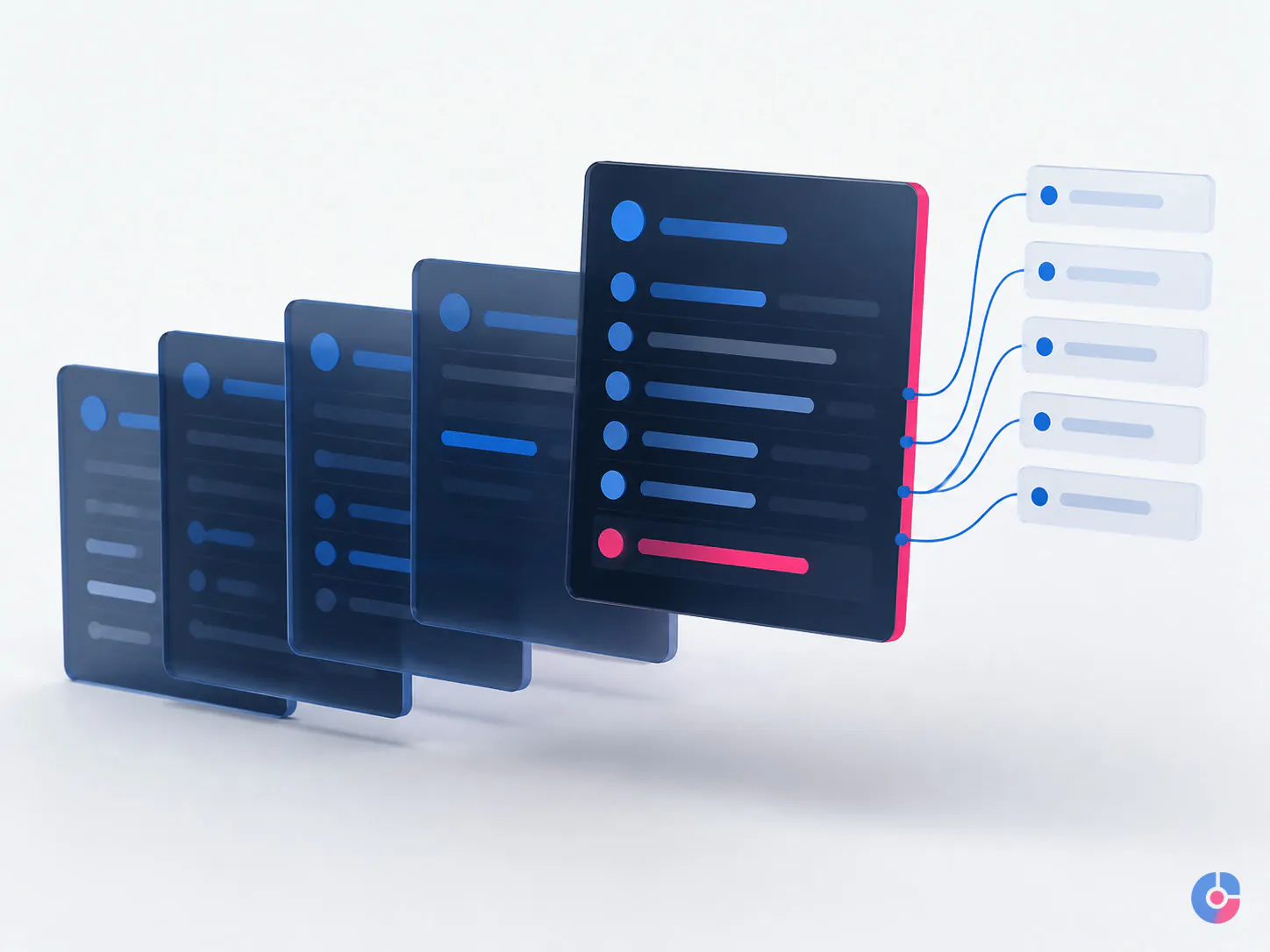
The five fields that change what a representative does
Choose five decision fields before buying data. The right set depends on the offer. A managed IT provider and a property-services company should not pay to populate identical schemas.
- Job title and normalized seniority. Preserve the source title, then map it to a controlled level such as manager, director or executive. The representative can decide whether the person owns the problem, influences it or should be used to find the owner.
- Employee-count band. Use a band tied to qualification or routing, not false precision. It can move an account to enterprise coverage, a founder-led sequence or disqualification.
- Industry classification. Store both the source label and your sales taxonomy. The value should select a relevant proof point, compliance treatment or team—not merely support reporting.
- A verified direct route. Define whether this means a confirmed work email, direct dial or another permitted contact method, and how recently it was checked. It should change the channel or prevent wasted attempts.
- One offer-specific qualifying signal. Examples include a supported ecommerce platform, a public multi-location footprint, a relevant license class or an active hiring pattern. State exactly what evidence qualifies and when a human must review it.
Use a copyable specification for every field:
- Field: employee count band.
- Allowed values: 1–10, 11–50, 51–200, 201–500, 501+ and unknown.
- Accepted sources: named official registry or company source first; named commercial source second.
- Maximum age: 180 days for this workflow.
- Confidence: confirmed, estimated or conflicting.
- Conflict rule: preserve the existing human-confirmed value and route the discrepancy for review.
- Sales action: 1–10 enters founder segment; 11–200 enters core segment; other values route to review.
If no sales action can be written, do not buy the field. More columns increase mapping, privacy, maintenance and conflict work. Completeness is not the same as usefulness.
Match rate is the wrong number to negotiate
A headline match rate can count a record as matched when any requested field is returned. A vendor might append a country to 95 records but supply a useful current contact route to 38. Both can be described as broad coverage unless the contract defines match at field level.
Coverage also varies by region, company size, sector and source visibility. A tool strong on large US technology firms may struggle with a 20-person manufacturer in another market. Average results across the vendor’s database are not evidence for your segment.
Run a paid sample on 100 records drawn from the population you will actually enrich. Include the real mix of regions, employee bands and record quality. Score each required field as correct, incorrect, missing, stale, inferred without an acceptable label or unable to verify. Also record conflict handling and source traceability.
Report results by field and segment. “Direct route: 63 returned, 51 verified usable, six wrong, six uncertain” is actionable. “82% matched” is not. Keep failed and ambiguous records in the denominator. If the vendor declines a representative test or will not define how a match is counted, decline the purchase.

Data decay makes enrichment a maintenance problem
People change roles. Companies merge, close, rebrand and change size. Domains and email policies change. A technology detected last quarter disappears. Even accurate enrichment begins aging as soon as it is delivered.
A widely repeated annual B2B database-decay percentage is often attributed to HubSpot, but a percentage without a clearly defined population, method and publication date is not a sound planning assumption. Measure decay on your own records. Take a cohort whose fields were verified on a known date. Recheck a representative sample after 30, 60 and 90 days, separating job change, company change, invalid route, field conflict and no longer qualified.
Set refresh cadence by consequence and signal. A direct contact route used in active outreach may need verification immediately before use. Company industry may change rarely. Employee band may be refreshed quarterly or at a trigger. Re-enrich when a message bounces, a representative records a role change, a domain redirects, an account re-enters a campaign or a material deal reaches review.
Do not promise deliverability. Google’s email sender guidelines tell senders to monitor bounces and deferrals, authenticate mail, increase volume carefully and observe reputation and recipient feedback. Accurate contact data supports sending hygiene, but delivery also depends on permission, relevance, authentication, reputation, volume and recipient systems.
Automated tools versus a managed enrichment team
A self-service tool wins when fields are standardized, source coverage is proven, volume is high and the workflow can accept deterministic results. It is fast, consistent and inexpensive per record. APIs can refresh data on triggers and write source timestamps automatically.
Tools tend to struggle where identity is ambiguous, the company is small, regional sources are uneven, a role changed recently or a qualifying rule requires context. Waterfall enrichment—asking several providers in sequence—can increase coverage but also creates conflicting values and makes source tracking essential.
A managed team costs more per record and moves more slowly. It can compare conflicting sources, interpret unconventional titles, inspect local registries, follow offer-specific rules and explain why a value remains uncertain. It should not hide judgement behind a “verified” label. Human research can still be wrong and needs sampling, evidence and reviewer calibration.
Use tools for high-confidence standard fields and people for exceptions, priority accounts and rules that require interpretation. Route low-confidence records to review instead of forcing a value. For genuinely new-account discovery, commission prospect research services rather than disguising list building as enrichment.
Get enrichment into the CRM without breaking it
Deduplicate before enrichment. If three records represent the same person, enrichment may append three slightly different titles and routes, multiply vendor cost and make the future merge harder. Use stable identifiers, cautious matching and a review queue for uncertain duplicates. Enriching a duplicated database multiplies the duplicates.
Map every incoming field to the CRM schema. Standardize picklists for industry, seniority, country and employee band. Preserve the raw source value when normalization changes it. Store source, collection or verification date, confidence and permitted use where the system supports them.
Write a source-of-truth rule before import. Human-confirmed data from a recent sales conversation should not be overwritten by an inferred vendor value. A newer official source may supersede an older commercial estimate. Conflicts should become visible exceptions, not “last write wins.” Test the mapping in a sandbox or limited batch and inspect automation triggered by the changes.
Routine mapping and record maintenance can be handled through CRM data entry services. Confirming whether a particular value is correct is a data-verification task. The enrichment scope should remain responsible for which fields are appended, from where and for which sales decision.
Compliance is part of the field specification
Technically obtainable data is not automatically lawful or defensible to collect, combine or use. Specify source categories, purpose, regions, retention, recipient type, suppression handling, transparency, security and vendor subprocessors before work begins. Require the provider to explain sourcing and contractual rights. “Publicly available” is not an adequate answer by itself.
For UK B2B marketing, the Information Commissioner’s Office explains that PECR treatment differs between corporate subscribers and individual subscribers such as sole traders and some partnerships. Its B2B marketing guidance also states that UK GDPR applies when business-contact personal data is processed, including publicly available information. Organizations need a lawful basis, appropriate privacy information and a process for objections.
If relying on legitimate interests in a relevant UK context, document the purpose, necessity and balancing assessment; do not assume the basis fits every field or campaign. Keep suppression records so an objection is not erased during a refresh. Apply consent and channel rules where required. Other countries and US states have different privacy, telemarketing and electronic-message regimes. Obtain qualified advice for the actual markets and channels.
Where a provider processes personal data on your behalf, define documented instructions, confidentiality, security, subprocessors, deletion or return and audit support in an appropriate data-processing agreement. A vendor unwilling to identify its sourcing or role is a vendor to decline.

Measure whether enrichment paid for itself
Use a control group. Randomly assign comparable records from the same segment to enrichment and no enrichment, then apply the same offer, sequence, representatives and time window. Without a control, seasonality, creative changes or sales behavior can be mistaken for data impact.
Track a small set of operational outcomes:
- invalid-route or bounce rate by source and verification age;
- connect rate for the chosen channel, with the denominator defined;
- qualified meetings per 100 records worked, not only per message sent;
- representative research time per prospect;
- disqualification rate and reason; and
- cost per usable field and cost per qualified record.
Compare confidence and source as well as vendor. If enrichment increases connects but not qualified meetings, the route may be better while the targeting field is weak. If representative research time falls but outcomes stay level, the project may still pay through capacity. State assumptions rather than invent a return figure.
A practical first project
- Select one commercial segment with enough records to evaluate and a defined sales motion.
- Write the five decision fields, allowed values, sources, age, confidence and sales action.
- Deduplicate and isolate records with missing stable identifiers.
- Run a paid 100-record sample that mirrors the segment.
- Manually score each field and inspect how CRM automations respond.
- Run a controlled sales test and measure operational outcomes.
- Scale only where field-level accuracy and usefulness hold; route ambiguous cases to review.
Plan in weeks, not promised meetings. One week may define and clean the sample, another may enrich and score it, and a sales test needs the length of the actual sequence plus follow-up. The timetable changes with list condition, fields and market. To test the workflow with your own records, get a sample enrichment on 100 records.
Bring a representative sample, your ideal-customer criteria and the sales decision each field should support. We will define the score before processing so missing and uncertain values remain visible. You can also book a free consultation or email support@ovelit.com.
Keep reading
Related insights

How to Triage Support Tickets
Backlogs are a queue design problem, not an effort problem. See how ticket triage, priority rules and SLA discipline keep customer support…

Sales Admin Tasks to Hand Off First
Reps lose selling hours to quotes, CRM updates and scheduling. See which sales admin tasks to hand off, in what order, and…

Outsourced SDR vs In-House Hiring
Outbound stalls when nobody owns it full time. Compare outsourced sales development with hiring an SDR, and see what each option really…