

Support & sales
Multichannel Customer Support Strategy
Adding channels adds cost unless the workflow behind them is shared. See how to design multichannel support that answers faster on the same team size.

A business switches on live chat because customers ask for faster answers. The same three agents now watch email, phone, chat and social inboxes. Chat interrupts email work, missed calls create follow-up tickets and first response on every channel gets worse. The tool is blamed, but the failure was operational: four front doors were added to one finite pool of attention without one queue, one staffing model or channel-specific service targets.
A useful multichannel customer support strategy begins with the shape of demand. It chooses channels for the contacts they handle well, sends every interaction into a shared record and staffs the arrival peaks rather than the daily average. That may mean deliberately not offering a fashionable channel. OVELITHUB’s multichannel customer support service applies this model to managed delivery.
Why adding a channel usually makes support worse first
A new channel creates more than a new inbox. It changes customer expectations, the timing of arrivals and the way agents work. Email can wait while an agent researches an answer. Phone and live chat create a live commitment. Social messages may be public before they become private. If one agent monitors all of them manually, each interruption leaves unfinished work and requires the agent to reconstruct context later.
The consequences travel beyond first response. A customer who receives no chat answer may email, call and post publicly about the same issue. Now one need has become several contacts. Separate agents may answer each one differently, issue duplicate refunds or ask the customer to repeat information. The real capacity problem is therefore not simply higher volume; it is duplicate demand and coordination work created by a fragmented system.
Do not launch a channel by adding a widget. Define the use case, advertised hours, entry message, queue, ownership, fallback, escalation and reporting first. If the current team cannot protect existing commitments during a trial, reduce the trial window or add coverage before promoting it.
Multichannel and omnichannel are different promises
Multichannel means customers can contact the business through more than one channel. Omnichannel means context and history follow the customer across those channels, so the next agent can see the prior interaction and continue it. A business can be multichannel while forcing the customer to start over each time.
Most growing teams need reliable multichannel operations first: clearly owned channels, a shared ticket record, consistent identity matching and dependable service targets. Omnichannel continuity is valuable, but it requires integration, data governance and disciplined agent behaviour. Claiming it before those foundations exist creates an experience the operating model cannot deliver.
The practical test is simple. When a customer calls after chatting, can the phone agent find the conversation, see what was promised and act without another retelling? If not, improve record continuity before adding another front door.
Choose channels from demand, not a competitor’s footer
What each channel is actually good at
- Email suits asynchronous issues that require attachments, research or a durable explanation. It is a poor emergency channel unless the response commitment and coverage support that promise.
- Live chat suits short pre-purchase questions, navigation help and factual account issues when an agent can respond during the advertised window. It becomes expensive when complex cases occupy a live slot for a long time.
- Phone suits distressed contacts, safety-sensitive situations, high-value decisions and conversations where rapid clarification prevents a long message exchange. It also demands real-time coverage and careful documentation after the call.
- Messaging apps can be appropriate where customers already use them for business communication. The team must still handle consent, identity, attachments, retention and handoff into the support record.
- Social messages often begin as reputation or marketing interactions and become support cases. Public acknowledgement and private resolution need a defined transfer.
- Self-service suits repeatable questions with stable answers, such as order status, return steps, password reset and common setup. It should offer a visible human route when the answer does not fit.
A channel is not inherently premium. It is useful when its interaction pattern matches the customer’s need and the business can operate it. Deeper implementation guidance belongs in the separate guide to live chat support services for ecommerce and the guide to running email customer support.
The disqualifying questions
Before launch, ask whether enough suitable demand exists to justify a live queue, whether the market or risk genuinely requires phone access, whether promised hours can be covered during absence and holidays, and whether the agent has the authority to resolve the likely contacts. Also ask what happens when the queue is full, the system is unavailable or the customer writes outside hours.
An unstaffed live channel is worse than no live channel because it makes an immediate promise and breaks it in view of the customer. A short, dependable service window is more honest than a permanently visible channel with uncertain attention. Remove or narrow a channel when suitable volume is consistently low, resolution quality is poor, duplication is high or staffing it damages more important queues.
Put one queue behind every front door
Every email, call record, chat and message should create or update one ticket in the system of record. The original channel remains visible, but identity, order or account context, prior contacts, status, ownership, priority, tags, promised next action and due time travel with the case. Agents work from assigned queues instead of scanning separate browser tabs.
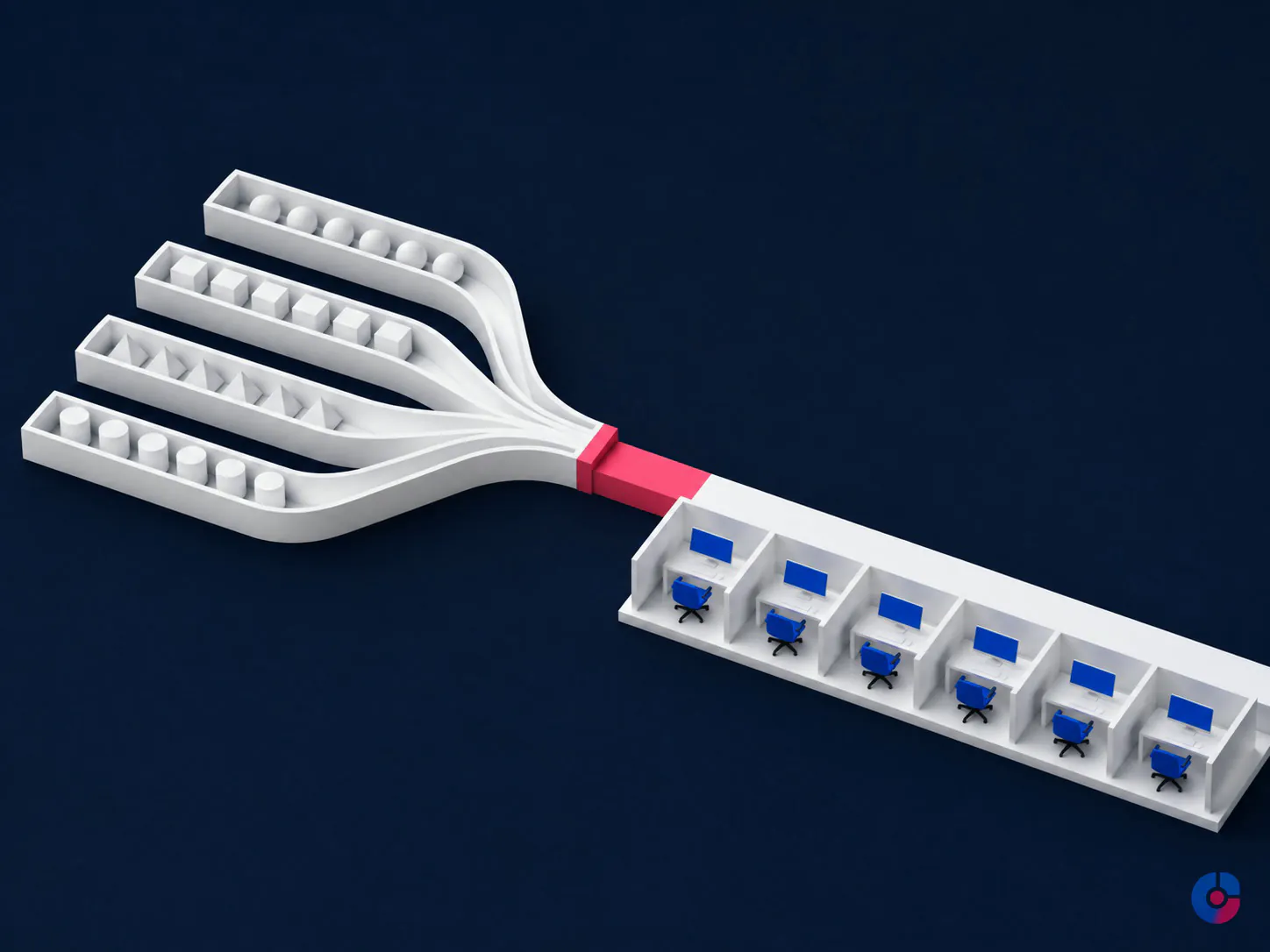
Routing rules should use information that changes the required treatment: language, customer tier, product, order state, risk, topic, urgency, region and specialist need. Do not create hundreds of tags that agents interpret differently. Begin with a controlled taxonomy covering contact reason, outcome, escalation and root cause. Define each tag, use mutually exclusive choices where possible and review an “other” bucket for missing categories.
A unified queue makes safe concurrency possible because the system owns the work state. When a live interaction pauses while the customer checks something, the agent can handle another eligible task without losing notes or deadlines. It also exposes repeat contacts: the agent can merge duplicates and address the original need once.
The trade-off is real. Consolidation requires a capable support platform, channel integrations, migration, permission design, agent training and tag discipline. A tool does not unify operations by itself. Assign a process owner who audits routing failures and maintains the taxonomy.
Deflect repeat contacts before adding staff
Start with the team’s own tagged demand. Rank contact reasons by volume and workload, then inspect the largest avoidable categories. Ecommerce teams often find questions about order status, delivery expectations, returns, product compatibility, address changes and payment failures. Other businesses will have different patterns. The point is to use observed reasons rather than importing a generic help-centre list.
For each category, decide whether the contact can be prevented, answered automatically or resolved through self-service. A clear delivery estimate can prevent a question. A proactive delay notification can prevent several. An authenticated order-status page can answer the customer without exposing data. A return flow can collect the required details once. Update confirmation messages and the product interface before writing another macro for a confusing policy.
Measure deflection carefully. Falling contact volume is useful only if customer outcomes remain acceptable. Monitor repeat-contact rate, failed searches, abandoned self-service journeys, cancellations, complaints and cases that arrive with higher urgency. Automation works well for stable, bounded requests. It works poorly when identity is uncertain, policy has exceptions or the customer needs a judgement, concession or safety decision.
Build staffing from arrival patterns and workload
Daily volume is not a schedule. Export contacts by 30- or 60-minute interval, day of week, channel and reason. Record average handle time for each group, including after-contact work such as notes and refunds. Then calculate workload minutes for each interval:
workload minutes = offered contacts × average active handle minutes
A hypothetical interval with 20 emails at eight minutes and 10 chats at twelve active minutes contains 280 workload minutes. That does not mean 4.67 people can simply be scheduled for an hour. The plan must also allow for uneven arrivals, waiting-time goals, breaks, coaching, meetings, absence, research, escalations and work that carries over. Small teams feel these effects sharply because removing one person changes a large share of capacity.

Chat concurrency is not a universal number. Measure active handling time, customer wait time between messages, issue complexity, error rate and quality scores. Start a new agent with one live conversation, test a cautious second conversation on simple queues and add more only when evidence shows that resolution and accuracy hold. A sales chat with short product questions and a technical account-recovery chat do not have the same safe concurrency.
Evenings, weekends and holidays create minimum-coverage problems. One person cannot simultaneously provide resilient live coverage and take an uninterrupted break. Options include shorter advertised hours, asynchronous fallback, scheduled on-call authority, cross-trained coverage or an overflow partner. The separate analysis of a 24/7 support team’s cost and coverage addresses round-the-clock economics.
Set service targets that expose the failing channel
First response time runs from receipt to the first meaningful human or approved automated response, not a receipt confirmation. Full resolution time runs until the customer’s need is resolved, with pause rules stated. Contacts per order or customer reveals preventable demand and duplicate outreach. Quality score samples whether the answer was accurate, complete, authorised, documented and appropriate in tone.
Set targets by channel, priority and advertised hours. A single blended response figure can look healthy while live chat is abandoned or email ages for days. Report the median and a tail measure, plus backlog age bands, reopen rate, transfer rate and repeat contact. Averages alone hide a small group waiting far too long.
Targets must connect to staffing decisions. If the business wants a tighter live response, it must fund enough coverage during peaks or narrow the window. If agents rush to meet handle-time goals and repeat contacts rise, the target is damaging the outcome. Review the whole chain rather than rewarding one convenient number.
Keep knowledge and macros consistent
The internal knowledge base should state the approved policy, decision logic, owner and review date. Agents need concise steps, examples, exceptions and escalation triggers—not a folder of long documents with conflicting versions. Search failed queries and quality-review findings to decide what to improve next.
Macros should provide structure, not impersonate a finished answer. They can confirm identity steps, explain a standard process and collect missing information. Agents must remove irrelevant text, insert the actual outcome and adapt length to the channel. Phone needs a call guide and clear notes; chat needs short turns; email can carry a fuller explanation.
Assign every macro and article an owner. Review high-use content monthly and immediately after a policy, product or system change. Retire duplicates. Sample the same contact reason across channels to find answer drift before customers do.
Write escalation paths for human decisions
Tier one should resolve repeatable, authorised contacts from documented steps. Escalate when identity cannot be verified, policy exceptions exceed a limit, fraud or safety is suspected, a system defect affects several customers, a high-value concession requires approval or the case needs legal, clinical, financial or technical judgement.
An escalation rule must name the trigger, destination, required evidence, urgency, customer message and fallback if the specialist does not respond. “Ask a manager” is not a rule. The receiving specialist should see a summary, actions already taken, screenshots or logs, desired decision and the time promised to the customer.
Remote agents should not guess beyond their authority. Give them enough system access to perform the agreed role, but keep high-risk actions behind approval or role-based permissions. Audit escalations for both overuse and dangerous underuse.
Where an outsourced support pod fits
Outsourced coverage fits tier-one repeatable contacts, overflow, seasonal peaks, weekend and out-of-hours queues, order and appointment updates, returns intake and documented troubleshooting. It fits best when systems, policy and escalation authority are clear. Contacts requiring unrestricted internal authority, clinical judgement, legal interpretation, sensitive investigations or undocumented executive discretion should remain with qualified client staff.
Customers notice a poorly briefed team quickly: the second reply repeats the first, misses the brand’s policy or asks for information already provided. Prevent that with brand and product onboarding, sandbox practice, calibrated quality reviews, restricted access, a named supervisor and direct feedback from the client’s policy owners. Good outsourcing should make governance more visible, not hide delivery behind a vendor label.

OVELITHUB’s operating model draws on delivery across ecommerce, healthcare and real estate workflows without assuming those industries can share the same authority rules. A support pod uses queue-level targets, daily workload review, sampled quality, coaching, escalation tracking and a regular client report. A remote customer support team can extend coverage, but the client remains responsible for policy, high-risk decisions and appropriate access.
A ninety-day channel rollout
- Days 1–30: measure and remove avoidable demand. Baseline arrivals, workload, backlog, repeat contacts, resolutions and quality by channel. Repair the top self-service, notification or product-content gaps. Define channel purpose and disqualifying conditions.
- Days 31–60: unify the work. Integrate current channels into one ticket record, simplify tags, establish routing and escalation rules, clean macros, train agents and confirm reporting definitions. Test failure and out-of-hours paths.
- Days 61–75: run a contained pilot. Add the new channel for limited advertised hours and a narrow contact scope. Protect existing queue targets, staff observed peaks and sample quality daily.
- Days 76–90: expand only on evidence. Compare incremental and duplicate contacts, resolution, quality, backlog and workload. Extend hours or use cases only when capacity and outcomes remain stable. Narrow or close the channel if it creates more failure than access.
This sequence treats channel growth as a controlled operational change. It also produces a defensible staffing plan: the leader can show which demand was prevented, when contacts arrive, what work remains, where concurrency is safe and which service promise additional coverage buys.
Keep reading
Related insights

How to Triage Support Tickets
Backlogs are a queue design problem, not an effort problem. See how ticket triage, priority rules and SLA discipline keep customer support…

Sales Admin Tasks to Hand Off First
Reps lose selling hours to quotes, CRM updates and scheduling. See which sales admin tasks to hand off, in what order, and…

Outsourced SDR vs In-House Hiring
Outbound stalls when nobody owns it full time. Compare outsourced sales development with hiring an SDR, and see what each option really…