

Support and sales desks
Cold Email Support Services for B2B
Cold email run on protected domains with proper authentication, warm-up and list hygiene. Reach the primary inbox and keep your main domain safe.
Bought under BPO Services From $350 per agent · live in 1 weeks

A cold email campaign can work, then quietly stop producing useful replies. The usual reaction is to rewrite the subject line, change the offer or add more mailboxes. None of those changes repairs failed authentication, a damaged sender reputation, a stale list or an opt-out process that is not working.
Delivery is also not a binary promise. A receiving provider evaluates identity, reputation, recipient response, content, sending pattern and its own user rules. A message can be accepted but placed outside the primary inbox. It can reach the inbox and still be irrelevant. OveliTHub’s cold email support services separate those questions so the team knows whether to fix infrastructure, targeting, the sequence or the offer.
We set up and operate controlled B2B outbound email programmes for approved prospects. The work covers brand-linked sending infrastructure, authentication coordination, input-list quality checks, sequence configuration, suppression, monitoring and reply handover. It does not include deceptive identities, scraped-list blasts, fake engagement or attempts to bypass a mailbox provider’s protections.
Your reply rate did not necessarily fall because of the copy
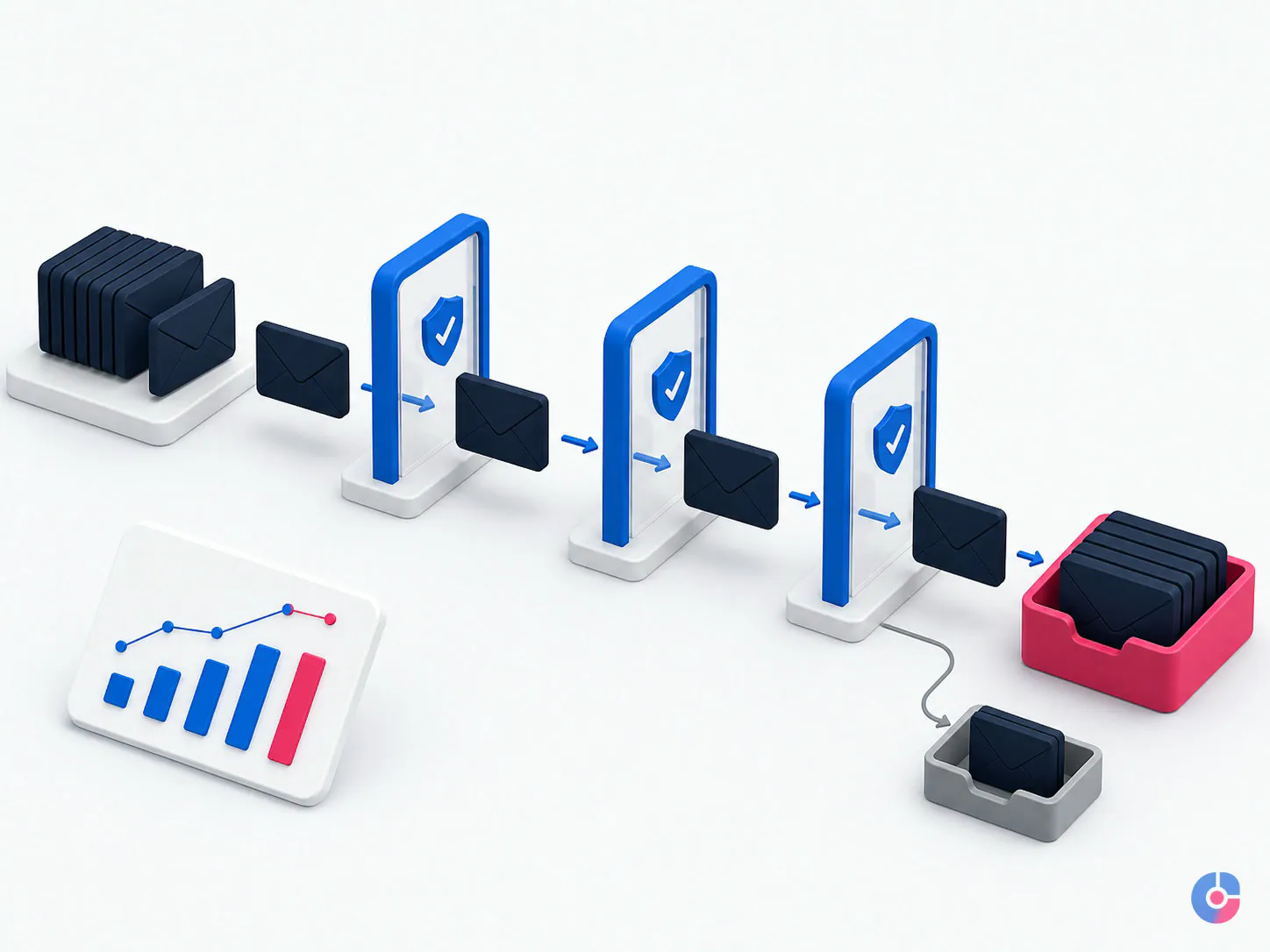
Replies are a downstream result. Before changing copy, we trace the path that produces them: a suitable organisation and contact were selected; the address was current; the sender was authenticated; the provider accepted and placed the message; the recipient understood who sent it; the proposition was relevant; and the response reached the right owner.
That distinction prevents false diagnosis. A sudden rise in hard bounces points towards data quality. Provider deferrals, rejections or authentication failures point towards infrastructure or policy. Complaints point towards expectation, targeting, frequency or message quality. Replies that say “not my role” point towards contact selection. Clean delivery with no commercial interest points towards the offer or market, not a DNS record.
We do not use open rate as the deciding signal. Tracking pixels can be blocked, preloaded or obscured by privacy features, so an “open” is not reliable proof that a person read a message. Delivery events, replies, qualified conversations, opt-outs and commercial outcomes provide more useful evidence. Where a client chooses tracking, its privacy and accuracy trade-offs are documented.
Protect the domain your business depends on
Invoices, support messages, employee correspondence and password resets should not share avoidable risk with outbound prospecting. We normally recommend a dedicated, client-owned, brand-linked domain or subdomain for an approved outreach programme, subject to the client’s provider, legal and security requirements. It should identify the real business, use truthful sender details and lead visibly back to the primary website.
This is operational separation, not a licence to send unwanted email. We do not establish deceptive lookalike domains, hide ownership or treat domains as disposable. Replacing a damaged domain to escape reputation controls simply moves the bad practice. The objective is to contain risk while building a stable, accountable sending history.
The client retains registrar ownership, recovery access and DNS authority. We document every sending domain, mailbox, tool, DNS record, owner, renewal date and approved purpose. The primary domain remains outside the outreach stream unless the client makes a documented exception after considering the risk.
Separation also has provider support. Yahoo’s current Sender Best Practices, checked 1 September 2026, recommends keeping bulk or marketing traffic apart from user, transactional and alert traffic because IP and DKIM-domain reputation can affect delivery. Separation reduces the blast radius; it does not guarantee placement.

SPF, DKIM and DMARC, in plain terms
Email authentication lets a receiving system test whether a message is connected to the domain it claims to use. The three records are related but not interchangeable:
- SPF lists the systems authorised to send on behalf of a domain. It must include the actual sending route without exceeding the standard’s lookup constraints.
- DKIM applies a cryptographic signature so the recipient can verify the signing domain and that signed content was not altered in transit.
- DMARC checks whether the visible From domain aligns with a passing SPF or DKIM identity, states how failed mail should be handled and can send aggregate reports to an approved destination.
A DMARC policy of p=none requests monitoring; it does not ask receivers to quarantine or reject failed mail. Moving to enforcement requires reviewing every legitimate sender, alignment and report first. We do not paste records from a generic template or change an existing policy without checking the other systems that use the domain.
Google’s current email sender guidelines, checked 1 September 2026, require all senders to personal Gmail accounts to use SPF or DKIM, valid DNS, TLS and properly formatted messages. Senders above Google’s bulk threshold must use SPF, DKIM and DMARC, meet alignment requirements and support easy unsubscribe for marketing or subscribed messages. Google identifies 5,000 or more messages in a day to personal Gmail accounts from the same primary domain as bulk sending.
Yahoo requires SPF or DKIM for all senders and both plus a valid DMARC policy for bulk senders. Both providers require reported spam rates below 0.3%; that is an outside limit, not an operating target. The safe response to complaints is to improve recipient choice, relevance and suppression—not to add sending identities.
Warm-up is controlled observation, not a switch
No universal number of days or messages makes a new mailbox “warm.” Provider, domain history, recipient mix, mailbox configuration and campaign behaviour differ. A vendor dashboard cannot grant permission to reach an inbox, and artificial conversations between mailboxes do not establish genuine recipient demand.
We authenticate first, confirm the sender profile and suppression path, then begin with a small, steady set of relevant messages. Volume increases only after reviewing acceptance, bounces, complaints, replies and provider signals. Sudden jumps are avoided. A mailbox that produces an unexplained negative signal is paused and investigated rather than balanced by opening more mailboxes.
The ramp plan records each mailbox’s start date, approved audience, daily maximum, send window, sequence, last change and current status. Limits are deliberately conservative and revised from observed evidence. Capacity follows the number of genuinely suitable recipients the business can contact responsibly; it is not manufactured through a mailbox farm.

List hygiene decides the campaign’s risk before a word is sent
The outreach list arrives as a controlled input. ICP definition, account selection and multi-channel planning belong to our B2B lead generation services; this service checks whether approved contacts are fit to enter the email channel. If the client needs role and company research before that point, prospect research services is the better starting place.
For every import, we record source and collection date, remove duplicates, compare against the global suppression file, check current company and role where evidence permits, validate address structure and domain status, and identify uncertain role-based or catch-all addresses for review. Verification tools reduce obvious errors but cannot prove that a person wants the message or that every accepted address belongs to the intended buyer.
Purchased data requires provenance and a client decision about lawful use, notice, contract restrictions and reputation exposure. We will not accept a bulk list merely because a vendor calls it “verified.” Old lists are rechecked because people change employers, domains expire and previous objections may sit in another system.
Suppression is permanent across the managed programme unless the recipient later makes a clear, documented request that lawfully changes the position. Hard bounces, complaints and opt-outs are removed from future campaigns. Soft bounces are classified and monitored; repeated failure is not retried indefinitely. The master record is checked before every sequence, not only when a campaign ends.
A sequence should earn attention, not imitate familiarity
Technical configuration cannot rescue a misleading message. The sender name, organisation, address and purpose must be accurate. Subject lines should describe the communication without false urgency. We do not create fake reply chains, pretend there was a prior conversation or insert invented personal facts.
Messages use a readable, restrained format with only the links and imagery the proposition genuinely needs. Personalisation comes from relevant company, role or operational evidence, not a first-name token presented as research. Each follow-up must add context or a useful decision path; repeating “just checking” increases frequency without increasing value.
The sequence has a defined stop rule. A reply, opt-out, complaint, hard bounce or disqualifying status stops automation immediately. Positive replies route to the named sales owner with the message history and response expectation. If OveliTHub is also qualifying and booking meetings, that downstream work is scoped under appointment setting services. Otherwise, the client owns the sales conversation from handover.
Tracking is minimised. Click wrapping can introduce unfamiliar domains and privacy concerns; open pixels are unreliable. When measurement is justified, the client approves which events are captured, how recipients are informed and how long data is retained. Replies and qualified outcomes remain the primary operating measures.
Compliance follows the recipient and market
“B2B” does not remove email law. The client is responsible for obtaining legal advice and approving the lawful basis, recipient categories, notice, claims and market. OveliTHub implements those approved rules in targeting, sender identification, message templates, records and suppression. If a market or contact type has not been approved, it does not enter the campaign.
For US commercial email, the Federal Trade Commission’s current CAN-SPAM compliance guide says the rules apply to business-to-business email as well as consumer email. It requires accurate header information and non-deceptive subjects, identification as an advertisement where applicable, a valid physical postal address, a clear opt-out method and honouring opt-outs within 10 business days. Hiring a provider does not remove the sender’s legal responsibility.
European and UK analysis is more context-dependent. Rules can differ by country, whether the address belongs to an individual or corporate subscriber, how it was obtained and whether consent or another lawful basis is available. Legitimate interests is not an automatic permission slip. The UK Information Commissioner’s electronic-mail marketing guidance should be assessed alongside applicable data-protection rules. The European Commission explains that people must be told about direct marketing and their right to object by the first communication at the latest; after an objection, processing for direct marketing must stop.
Our operational standard is faster than the longest legal deadline: opt-outs are actioned as soon as they arrive, propagated to the master suppression record and checked before any subsequent send. Every template carries truthful sender identification, an approved postal address and a straightforward way to stop contact. Legal rules are a floor; relevance and recipient respect remain necessary above it.
Monitor daily, and pause before damage spreads
The daily control view covers message acceptance, hard and soft bounces, provider deferrals and rejections, authentication results, complaints where feedback is available, opt-out processing, reply classification and meaningful blocklist signals. Placement tests can indicate a change in a controlled seed panel, but they do not prove how every real recipient’s provider will place a message.
| Signal | Immediate action | Evidence required to resume |
|---|---|---|
| SPF, DKIM or DMARC failure | Pause the affected identity and trace DNS, signing, alignment and sending route. | Passing message headers from the real route and confirmation that other authorised senders remain valid. |
| Hard-bounce or invalid-recipient increase | Stop the affected list segment, suppress failures and audit source, age and verification. | Corrected data source, clean suppression comparison and a reviewed sample. |
| Complaint signal or provider warning | Pause the related audience and sequence; do not spread it across new mailboxes. | Root-cause review of relevance, expectation, frequency and consent or lawful-basis controls. |
| Repeated deferrals or permanent rejection | Classify the provider code, stop improper retries and investigate reputation, policy and technical causes. | Resolved cause, current provider guidance and a controlled restart plan. |
| Opt-out processing failure | Pause all affected sends until suppression is dependable. | Tested opt-out route, reconciled records and proof that queued contacts are suppressed. |
Google and Yahoo both publish a 0.3% reported-spam ceiling for affected senders. We do not wait to reach it. Any sudden complaint trend, provider warning or control failure triggers review, with stricter programme limits agreed from the audience and provider mix. A pause is a protective control, not a failed campaign.
What we run and what stays with you
| OveliTHub manages | The client owns and approves |
|---|---|
| Documented sending-domain and mailbox setup, tool configuration and authentication coordination. | Domain ownership, security access, provider contracts and the decision to use outbound email. |
| Input-list QA, duplicate control, suppression and sequence loading. | ICP, contact-source provenance, lawful basis or consent, recipient-market rules and exclusion policy. |
| Approved message formatting, pacing, sending, signal review, pause control and reporting. | Offer, pricing, factual claims, brand approval, physical address and legal review. |
| Reply classification and handover with campaign context. | Sales response, qualification decisions, proposals and the customer relationship. |
This outbound scope is intentionally distinct from email management services, which organises and triages an existing inbox, and email support services, which handles customer-service conversations. For readers assessing the channel before buying, our cold email deliverability checklist explains the readiness questions in more detail.
Start with a domain and deliverability audit
- Inventory the sending estate. Record domains, mailboxes, DNS ownership, tools, sending routes, lists, sequences, suppression stores and reply destinations.
- Inspect authentication. Test SPF scope, DKIM signing and DMARC alignment from real message headers, then review policies and aggregate-report handling.
- Review reputation signals. Examine provider errors, deferrals, bounces, complaint data, prior volume changes and relevant blocklist evidence without assuming a single score explains delivery.
- Audit data and compliance controls. Sample source evidence, contact currency, duplicates, suppression, sender identification, postal address, opt-out handling and market approval.
- Write the risk-ordered plan. Separate immediate stop issues, technical remediation, list correction, sequence changes and controlled ramp conditions.
- Approve before sending. Name the decision owners, operating limits, pause triggers, reply route and legal sign-off for each recipient market.
The audit may recommend repairing an existing programme, establishing a clean brand-linked stream or stopping a list that cannot be supported. It does not promise inbox placement or replies. It gives the business a defensible operating position before more prospects—and more domain reputation—are put at risk.
Get the evidence before increasing volume
OveliTHub has delivered more than 130 projects across the USA, Europe and the Middle East. The first deliverable for cold email is a written audit of authentication, sender separation, list and suppression controls, provider signals, blocklist evidence, sequence configuration and reply routing.
Book a free consultation, email support@ovelit.com, or call +880 1707-510532. You can also review the wider range of digital services.
Set at the service, not here
The terms every BPO services engagement runs on
The price, the ownership and the renewal terms are the same whichever offering you buy, which is why they are published once rather than restated on every page.
- Starting price
- From $350 per agent per month, in US dollars. 4 hours a day, 5 days a week, one channel, documented SOPs and a monthly QA report. Live in 2 weeks
- Channels
- Email, live chat, phone, social inboxes, CRM and back-office systems
- Coverage
- Hours are stated per desk and written into the agreement, including which of your working days are covered from UTC+6
- Data protection
- UK GDPR Article 28 processor agreement, Standard Contractual Clauses and the UK IDTA where data leaves the UK or EEA
- Quality
- Monthly QA scoring against a rubric you approve, with the sampled tickets attached
- Tooling
- We work inside your helpdesk and your CRM. No forced migration to a platform we own
How long does setup take before the first send?
There is no responsible universal timeline. It depends on domain ownership, DNS access, provider provisioning, existing reputation, data readiness, legal approval and test results. We issue a readiness plan after the audit and start only when authentication, suppression and ownership controls pass.
How many domains and mailboxes do we need?
We derive capacity from the approved audience and conservative operating limits. We do not multiply mailboxes to force a volume target or work around provider controls. A focused market may need very little infrastructure; an unsuitable high-volume plan may be declined.
Can you work with our existing sending tool?
Yes, if it supports the required authentication, suppression, permission controls, export, reply routing and monitoring. The audit checks the real sending route and headers. If the tool cannot enforce a critical control, we document the gap and recommend a migration or narrower use.
Do replies come into our inbox?
Usually. Replies can route to a client-owned mailbox or an agreed shared workspace, with ownership and response expectations defined in advance. Automated sending stops on reply. OveliTHub classifies and hands over responses only within the agreed scope.
What if our domain already has a poor reputation?
We first stop the behaviour causing damage, confirm authentication and list controls, review provider evidence and protect critical mail. Recovery is not guaranteed and cannot be assigned a fixed date. A new sending stream is considered only for legitimate separation, never to continue the same practice under a new identity.
When should we expect the first replies?
No provider can responsibly guarantee a reply date or rate. Timing depends on recipient fit, list currency, delivery, offer, message, season and sales follow-up. Early reporting distinguishes technical delivery from qualified response so the team improves the correct layer.
Is cold email legal in Europe?
There is no single yes-or-no rule for every European recipient. Country, recipient type, channel rules, data source, consent or other lawful basis, transparency and objection rights all matter. The client must obtain appropriate legal advice; we implement the approved market rules and exclude contacts that do not meet them.
Bought together
Also in support and sales desks
LinkedIn Lead Generation Assistant
A dedicated assistant prepares LinkedIn research, personalised message drafts and daily action queues while the profile owner controls account activity.
What it coversInbound Call Center Services
Trained inbound agents for overflow, after-hours and full-time call handling, staffed to your real call pattern so fewer callers hang up and…
What it coversLead Generation Assistant for Sales Teams
A dedicated lead generation assistant to build accurate target lists, research accounts, log everything in your CRM and hand reps a ready…
What it coversNext step
Tell us what you need from Cold Email Support Services for B2B
Volume, hours and the systems it has to run in. The first reply carries a scope and a figure rather than a request for the basics.
- You send the brief A few lines is enough. No form fields you have to guess at.
- We reply in one business day With questions if we have them, and a range if we do not.
- You decide, not us No retainer to talk. If it is not our work, we say so.
Ask about Cold Email Support Services for B2B
Priced per agent per month. The written procedure comes before the first agent is hired, so say what the work actually is.
We use what you send to answer you. We do not sell it, and we do not add you to a list.