Marketing & creative
Blog Publishing Support Services
Turn approved drafts into properly published, indexed posts on schedule. On-page setup, internal linking, images and republishing handled for you.

The expensive content asset is often not the commissioned article. It is the approved draft that has been sitting in a folder for nine weeks because nobody resized the images, added the links, checked the fields and took responsibility for publishing it. The writing budget has been spent, but the page cannot be crawled, shared, cited or used by sales because it does not exist on the site.
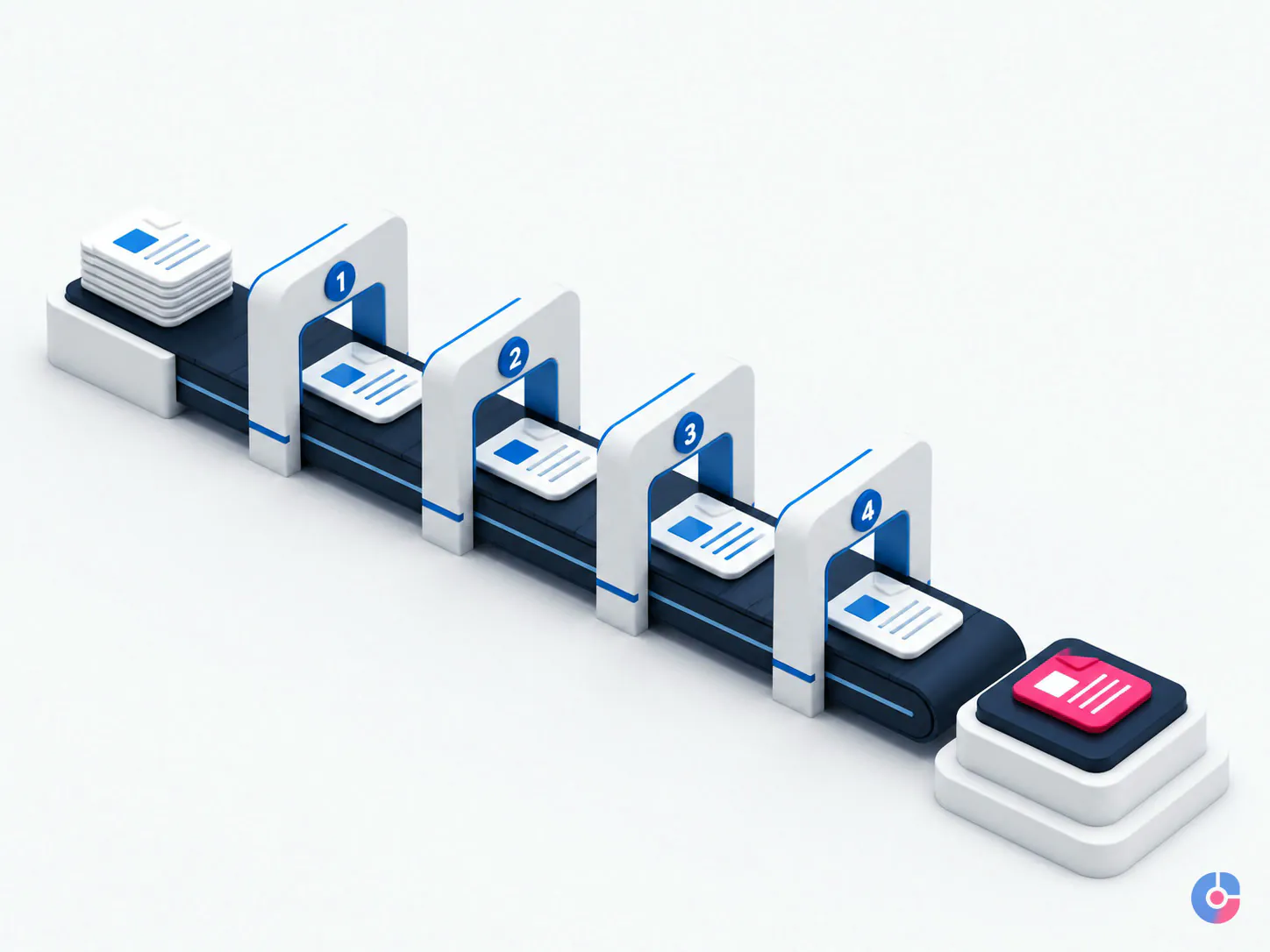
OVELITHUB provides blog publishing support for marketing teams and agencies that already have writers, approved drafts and a site. We turn those inputs into properly configured live posts through a repeatable production line: intake, formatting, image handling, metadata, linking, review, scheduling, post-publication checks and documented handback.
This service owns the last mile between approval and a functioning page. It does not promise rankings, choose the content strategy or quietly rewrite an author’s argument. Its value is controlled throughput: shorter draft-to-live time, fewer publishing defects and a content library that remains connected after the publish button is pressed.
Draft-to-live time is a metric worth tracking
Organic content may accumulate discovery, links, engagement and internal usefulness over months. Every week an approved post remains offline removes a week from the front of that possible lifetime. The exact traffic outcome is uncertain, but the delay is certain: search engines cannot index an unpublished URL, customers cannot read it and existing pages cannot link to it.
We track draft-to-live time from approved intake to successful post-publication check. The clock pauses only for a named dependency such as missing approval, unresolved factual question, absent rights confirmation or a technical issue outside publishing access. This separates production delay from editorial delay and shows where the queue actually stops.
A fast process is not a careless one. The useful target is predictable flow through defined quality gates. Urgent publishing can be supported when capacity and approval are available, but making every post urgent destroys the buffer that protects the regular cadence.
Our definition of done for a published post
A draft is not complete when text has been pasted into a CMS. OVELITHUB applies a client-approved checklist and keeps evidence of the final review. The exact fields vary by platform, template and content type, but the production standard covers the following.
- Approved source confirmed. The editor works from the correct final draft, resolves tracked changes and records the approver and intake date.
- URL and status controlled. The slug follows the site convention, avoids accidental duplication and remains draft or staging-only until approval.
- Title and description entered. The title element and meta description are unique, accurate and concise, with a device-aware preview rather than an invented character limit.
- Heading hierarchy checked. The page uses one intended primary heading under the template, meaningful H2 and H3 structure, and no headings used merely to create visual styling.
- Body formatting reviewed. Paragraphs, lists, tables, callouts, quotations, code, footnotes and special characters render consistently with the site.
- Links validated. Internal destinations are relevant and live, external citations open to the intended source, and anchor text describes the destination.
- Images prepared. Assets have approved rights and source, suitable dimensions and format, compression, descriptive filenames, functional alt text and captions where useful.
- Taxonomy kept clean. Author, publication or updated date, category, tags and series fields follow the established convention without creating near-duplicate terms.
- Structured data confirmed. The platform’s applicable article or other markup is present, accurate and consistent with visible content; unsupported schema is not added for decoration.
- Social and sharing fields reviewed. Where the template supports them, Open Graph or equivalent title, description and image use the approved asset and page framing.
- Responsive render inspected. Desktop and mobile checks cover overflow, image crop, tables, embeds, links, spacing, navigation and readable text.
- Publish and verification completed. The live URL, canonical, status code, visible date, links and intended indexability are checked after release.
Google’s current guidance supports quality rather than legacy length rules. Its title-link documentation says there is no fixed limit for a title element and recommends unique, descriptive, concise text; its snippet guidance says meta descriptions also have no fixed limit and may be truncated for device width. Google may generate a different title link or snippet, so publishing checks confirm the supplied signals without promising exact search-result display.
The image handling standard
Assets arrive through the client’s approved library, licensed source, internal designer or separately agreed production scope. The publishing editor confirms which image belongs to the post and whether the documented use is permitted. We do not take an image from search results, assume a licence or publish an unapproved generated likeness.
Each image is prepared for its actual slot. Dimensions match the template’s display requirement; format and compression reduce unnecessary transfer size without visible damage; the filename describes the asset; and width and height are supplied where the CMS supports them to reduce layout movement. Featured, inline and social crops are not assumed to be interchangeable.
Alt text is written for a person who cannot see the image. It states the relevant visual information or function in context, without stuffing keywords, repeating the caption or adding “image of” unnecessarily. A decorative image can use the site’s appropriate empty-alt treatment. Captions are added when source, interpretation or context helps the reader.
Image work affects usability and performance because oversized assets add avoidable page weight and missing dimensions can disrupt layout. We inspect the rendered page and follow the client’s performance budget. Google’s current image SEO guidance also emphasises high-quality, contextual images and appropriate page signals; it does not replace accessibility or licence review.
Internal linking is the step most teams skip
Publishing requires links in two directions. First, the new post should point to relevant existing service pages, hubs, evidence and deeper explanations. Those links help readers continue and place the article inside the site’s subject structure. They should be selected for context, not added to meet a quota.
Second, relevant existing pages should be updated to link into the new post. This retro-linking step is operationally harder because it requires searching the library, selecting source pages, adding useful anchor text and republishing them. It is also the step most likely to be forgotten once the new URL is live.
Our release ticket contains an inbound-link list before publication. We search approved hub and article groups for passages where the new page genuinely expands the idea. Each edit preserves the source page’s meaning and is recorded. We do not force exact-match anchors, add links to unrelated high-traffic pages or rewrite a paragraph simply to manufacture relevance.
When a post replaces or consolidates older content, the linking plan includes redirects, canonical intent and updates to internal destinations. That change is reviewed separately because it can affect existing URLs and reporting.

Publishing cadence and the editorial queue
The queue begins only when a draft meets the intake standard: approved text, intended URL or topic, author, category, media, citation status, desired date and named approver. Incomplete drafts enter a dependency view rather than silently occupying a publishing slot.
Posts are scheduled against an editorial calendar with realistic production capacity, review time and site blackout periods. A ready buffer protects the cadence when one article encounters a factual question or missing asset. Consistency matters more than a brief surge followed by silence because the team can coordinate promotion, review and internal links around a predictable release.
The calendar distinguishes writing, approved, in production, awaiting client, scheduled, live, post-checked and refresh-due. It does not attempt to manage social, email and repurposing workflows under this service. Teams needing a named operator across several content channels should consider a content publishing assistant.

The refresh cycle for posts already published
An established blog often contains pages whose citations, screenshots, examples, product details or internal links have aged. Ahrefs’ 2026 content-decay guide describes a practical decision set: update, consolidate, redirect or prune based on the page’s current condition and purpose. We use performance and content evidence to prepare a refresh queue; we do not assume changing a date will improve visibility.
A refresh ticket can include:
- checking whether the topic and search or audience need remain relevant;
- revalidating facts, statistics, policies, prices and external citations;
- replacing stale screenshots, broken embeds and unavailable examples;
- adding useful newer pages to the internal-link structure and fixing broken destinations;
- removing unsupported or obsolete sections without erasing necessary context;
- reviewing the title, description, heading structure and page presentation; and
- recording what materially changed and using an updated date only when the site’s editorial policy supports it.
The content owner approves factual and strategic changes. The publisher implements the approved revision, preserves or changes the URL only under an explicit plan, completes the live checks and annotates the reporting timeline. Republishing does not guarantee restored traffic, and some pages are better consolidated or retired.
Technical checks after publishing
The live-page check confirms a successful status response, intended canonical, indexability setting, sitemap or discovery path where the site uses one, rendered body, media, embeds and links. If the CMS produces a preview URL or duplicate parameter version, the editor verifies that the public canonical points to the intended clean URL.
Indexing is observed rather than guaranteed. A publisher can request or support discovery through the client’s established tools and confirm whether a page is eligible, but search engines decide when and whether to crawl and index. A noindex rule, canonical conflict, blocked resource or authentication issue is escalated with evidence.
If a URL changes, the old-to-new redirect is specified and tested, and internal links are updated to the final destination. We do not create redirect chains casually or change a live slug for cosmetic preference. Broken external links, missing media and failed embeds are corrected or routed to the content owner.
This is a release check, not a full technical SEO audit. Sitewide crawl architecture, rendering systems, performance engineering and ranking diagnosis need a separate specialist scope such as SEO assistant services.
Working in your existing stack
OVELITHUB works in the client’s current publishing environment. That can include WordPress, Webflow, HubSpot, Shopify blogs or a documented headless workflow, alongside approved editorial tools such as Google Docs, Notion, Asana or Trello. A migration is not required for publishing support.
Onboarding maps roles, draft states, templates, custom fields, reusable blocks, media library, plugins or integrations, staging, approvals, scheduling, backups and rollback. Headless setups need a defined repository or CMS route, build responsibility, preview environment and deployment owner. We do not push code or production changes outside the granted role.
Access is named and least-privilege. Publishing rights can be separated from plugin, theme, user and infrastructure administration. Multi-factor authentication is used where supported, credentials are not shared, and offboarding is requested promptly when access is no longer needed. The client retains ownership of its CMS and source systems.
What we do not do under this scope
- We do not choose the content strategy, target keywords or editorial positioning; clients needing that direction should review digital marketing services.
- We do not draft or substantively rewrite posts unless content creation is separately agreed and approved.
- We do not translate or adapt a post for another market under the publishing ticket; that belongs to content localization.
- We do not design a new featured-image system or campaign graphics as a hidden publishing task.
- We do not publish a factual claim, broken citation, rights concern or unsafe instruction simply because a deadline exists. The item is flagged to the approver.
- We do not promise indexing, ranking, traffic or a particular search-result title or snippet.
Staying inside these boundaries makes responsibility clear. The content owner approves meaning; the publishing team owns accurate production and release.
Get the publishing checklist and a proposed cadence
OVELITHUB has delivered more than 130 projects, with digital marketing as a core service pillar. Share your CMS, template, backlog and current approval route; we will map the checklist and recommend a release cadence the team can sustain.
Book a free consultation, email support@ovelit.com, or call +880 1707-510532. For a self-service starting point, use our SEO blog publishing checklist or browse the full range of digital services.
Keep reading
Related insights

WordPress vs Custom CMS Development
A custom CMS buys control and a permanent maintenance bill. Compare both against your content model, team and five-year plan before you…

BPO Services for Digital Marketing: Benefits
Marketing teams stall on execution, not ideas. See which marketing functions a BPO model absorbs, what it returns in hours, and where…

What SEO Services Actually Deliver
SEO is four separate disciplines sold as one word. See what each part does, what results it can produce, and how to…
Next step
Want this done rather than explained?
Tell us what needs doing and by when. You get a scope, a price range and an honest view of whether this is the right work for you at all.
- You send the brief A few lines is enough. No form fields you have to guess at.
- We reply in one business day With questions if we have them, and a range if we do not.
- You decide, not us No retainer to talk. If it is not our work, we say so.
Ask about Digital Marketing
We use what you send to answer you. We do not sell it, and we do not add you to a list.